


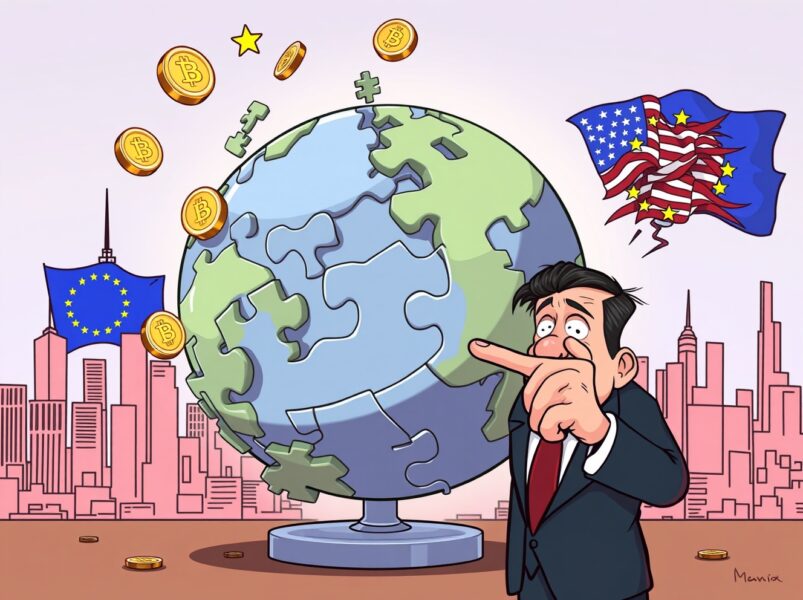
French President Emmanuel Macron has issued a critical warning, stating that easing crypto regulations in the United States could set the stage for a global financial crisis. This statement challenges the regulatory direction of the world's largest economy.
Why Is Macron Sounding the Alarm on Crypto Regulations?
President Macron expressed deep concerns about the current trajectory in the U.S., believing that rules for cryptocurrencies and stablecoins are becoming dangerously lax. His core argument is that allowing this sector to grow without robust guardrails invites systemic risk. Consequently, he has urged the European Union to firmly resist following the American lead, advocating for a more cautious and structured approach to crypto regulations.
What’s at Stake with Lax Financial Rules?
Macron's warning centers on financial stability, as cryptocurrencies and stablecoins are increasingly intertwined with the traditional financial system. If crypto regulations are too weak, several issues could arise:
- •Contagion Risk: A major failure in a large crypto firm or a stablecoin de-pegging could have ripple effects into banks and investment funds.
- •Investor Protection: The absence of clear rules leaves retail investors more exposed to fraud, market manipulation, and significant losses.
- •Monetary Policy Challenges: The widespread adoption of unregulated stablecoins could undermine a central bank's ability to manage the economy effectively.
Macron fears that the U.S.'s softer stance could export this instability to other parts of the world.
The EU vs. US: A Clash of Crypto Philosophies?
This warning highlights a growing divergence in global crypto regulations. The European Union has proactively established the Markets in Crypto-Assets (MiCA) framework, a comprehensive set of rules for the bloc. In contrast, the U.S. has a more fragmented approach with ongoing debates among various regulatory bodies. Macron's statement is a clear endorsement of the EU's model, framing it as a necessary shield for the global financial system rather than a barrier to innovation. He positions strict crypto regulations as a prerequisite for sustainable growth.
What Does This Mean for the Future of Crypto?
Macron's intervention raises crucial questions for investors and the industry. It prompts consideration of whether the U.S. will reconsider its regulatory pace and how this transatlantic tension might affect global crypto companies operating in both jurisdictions. More importantly, it forces a fundamental debate: should the primary goal of crypto regulations be to foster rapid innovation at any cost, or to ensure long-term stability and protect the broader economy? The path chosen will significantly define the next decade of digital finance.
In conclusion, Emmanuel Macron has delivered a stark warning into the heart of the crypto debate. His message is unambiguous: treating cryptocurrency with a light regulatory touch is a perilous gamble with global stability. As the EU forges ahead with its structured framework, the world will be watching to see if the U.S. heeds this cautionary tale or doubles down on its current course. The stakes for the financial system have never been higher.
Frequently Asked Questions (FAQs)
What exactly did Macron say about U.S. crypto rules?
French President Emmanuel Macron warned that cryptocurrency and stablecoin regulations in the United States are becoming too lax. He stated that allowing the sector to grow without strict rules could lead to global financial instability.
Why does Macron think this is a problem for Europe?
Due to the interconnected nature of the global financial system, a crisis originating in the loosely regulated U.S. crypto market could easily spread to European banks, investors, and economies.
What is the EU doing differently with crypto regulation?
The EU has implemented the Markets in Crypto-Assets (MiCA) regulation, a comprehensive framework that sets clear rules for crypto issuers and service providers across all member states, aiming for harmonized consumer protection and financial stability.
Are stablecoins a particular concern in this warning?
Yes. Stablecoins, which are designed to maintain a stable value, are specifically mentioned. If a major stablecoin were to fail or lose its peg in an under-regulated environment, it could trigger rapid, widespread sell-offs and liquidity crises.
What can an individual crypto investor learn from this?
This highlights the importance of regulatory clarity for market safety. Investors should pay close attention to the regulatory environment of the projects they support, as stronger regulations can mean reduced risk of fraud and systemic collapse.
Could this warning actually change U.S. policy?
While it adds significant international pressure, U.S. policy is determined domestically. However, warnings from a key ally like France could influence the debate and encourage lawmakers to consider the global implications of their decisions.