


US-based cryptocurrency exchange Coinbase is set to re-open its app in India, marking its return to the market after an absence of more than two years. John O’Loghlen, the exchange’s APAC director, announced Coinbase’s re-launch in the Indian market during his participation at India Blockchain Week (IBW).
Trading Capabilities and Future Fiat Integration
Coinbase initially launched its services in India in 2022, offering support for the Unified Payments Interface (UPI) payment network. However, this integration was short-lived, as the UPI operator, National Payments Corporation (NPCI), reportedly refused to acknowledge Coinbase’s presence in the country, leading to the termination of UPI support just days later. This situation ultimately resulted in Coinbase shutting down its services for Indian traders in 2023.
Since its exit, Coinbase has been actively working to re-establish its presence in India. The company initiated engagement with the Financial Intelligence Unit (FIU), a government agency responsible for overseeing transactions and fraud. Earlier this year, Coinbase successfully registered with the FIU, a crucial step that paved the way for the exchange to begin onboarding users through an early access program in October. The app is now officially open to all users.
Currently, users can perform crypto-to-crypto trades using the Coinbase app. O’Loghlen confirmed that a fiat on-ramp feature will be introduced soon, which will enable users to deposit fiat currency and execute fiat-to-crypto trades within the app.
Navigating India's Crypto Market Landscape
India presents a challenging environment for crypto exchanges to operate within. A significant factor is the country's tax policy, which levies a 30% tax on crypto income without any provision for loss offset. Additionally, regulators impose a flat 1% deduction on each transaction, which can deter higher-frequency trading activities on exchange platforms.
Addressing the current tax policies in India, O’Loghlen expressed Coinbase's hope that the government will consider relaxing the taxation framework to facilitate easier crypto holdings for investors. Despite these regulatory and tax hurdles, Coinbase maintains an optimistic outlook for the Indian market. The company’s venture arm has recently made a substantial investment of over $2.45 billion into CoinDCX, a local Indian platform, at an equivalent post-money valuation.
There are 100M+ crypto owners in India and the Middle East. And that’s growing, fast.
We're excited to expand our presence in these regions through a new investment into India's leading exchange, @CoinDCX. pic.twitter.com/4anCrwiK5o
— Coinbase 🛡️ (@coinbase) October 15, 2025
Coinbase also plans to expand its team in India, which currently comprises approximately 500 employees.
India's Leading Position in Crypto Adoption
The Indian market holds a prominent position in global crypto adoption, ranking first among countries including the United States, Pakistan, the Philippines, and Brazil. This ranking is according to a report published in October by TRM Labs.
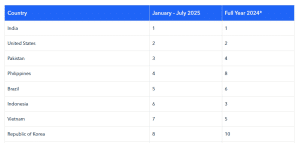
India has consistently secured the number one spot in crypto adoption rankings for the past three years.
Other Exchanges Re-entering the Indian Market
Coinbase is not the only cryptocurrency exchange making efforts to capture a share of the significant Indian market. Kraken, Binance, and Bybit have also recently made strategic moves to re-enter or strengthen their presence in India.
In early 2025, Kraken began taking steps towards re-entering the Indian market. These initiatives included appointing Indian entrepreneur Vinesh Khurana as an advisor to lead its India operations. Kraken has also been actively engaging with local regulators and is in the process of applying for the necessary licenses to operate as a fully compliant business.
Meanwhile, Binance re-entered the Indian market in August 2024 after registering with FIU-IND as a "reporting entity," thereby fulfilling the required regulatory obligations. The exchange also paid a penalty of $2.25 million to the regulators.
Bybit announced in September that it had restored full access to its app on both the App Store and Google Play for users in India.