


Coinbase CEO Brian Armstrong attended the World Economic Forum Annual Meeting in Davos on January 20th to discuss cryptocurrency advancements with global leaders. The meeting's focus on economic freedom, market structure legislation, and asset tokenization could influence future regulatory and financial strategies in the digital economy.
Armstrong Advocates Cryptocurrency Integration at Davos Forum
Brian Armstrong was in Davos to discuss cryptocurrency's role in economic freedom at the World Economic Forum. The agenda included how digital currencies can enhance financial systems and their advancing market structure. Armstrong planned to advocate for asset tokenization to democratize capital access.
Furthering his efforts, Armstrong continued to challenge existing regulatory frameworks, focusing on decentralization and reduced compliance burdens. The intent is to prevent innovation outflows to ensure more inclusive financial systems worldwide.
The presence of Donald J. Trump, alongside a significant U.S. delegation, reflects the strategic importance placed on technology and finance, including Armstrong's viewpoints. Armstrong stated, "The Trump effect cannot be denied. To have the leader of the largest GDP country in the world come out undeniably and say that he wants to be the first crypto president, he wants the industry to be built in America and he's going to direct every agency of the US government to work towards clear rules which enable innovation – this is unprecedented."
Crypto Market Insights Amid Davos Dialogues
In past Davos forums, the intersection of regulation and crypto innovation has often signaled strategic pivots for U.S. policy, as seen in 2025 discussions influencing regulatory clarity before the February 2026 deadlines.
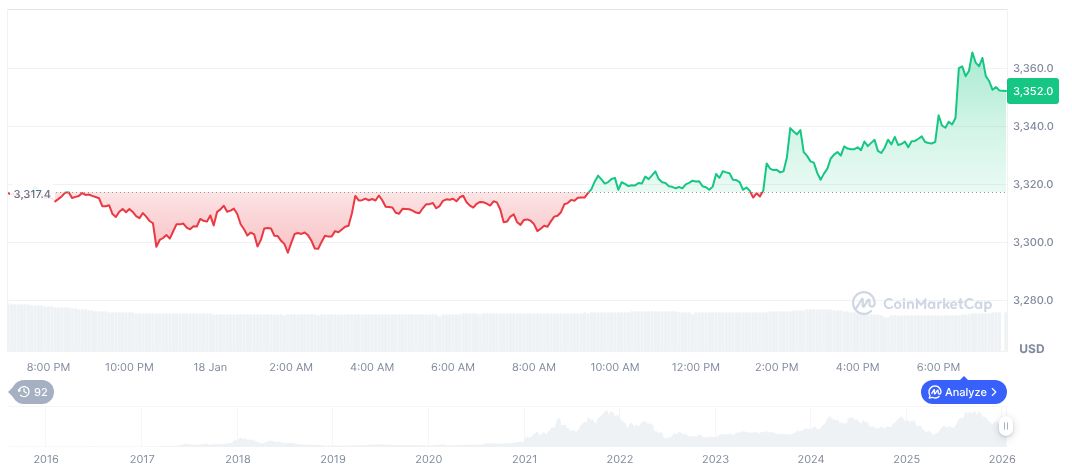
Ethereum (ETH) stands at $3,217.57, with a market cap of $388.34 billion, commanding a 12.34% market dominance. Recent price activity shows a decrease of 3.48% over 24 hours but a 2.81% increase in the last week.
Armstrong's advocacy might lead toward a more crypto-inclusive regulatory framework, possibly reducing barriers for emerging technologies. Historical trends show that leadership dialogues at high-profile forums often precede significant policy amendments.