Key Developments in Trade Relations
China and U.S. economic teams concluded productive talks in Kuala Lumpur on October 26, reaching a framework agreement, easing potential trade tensions between the two nations.
This agreement could stabilize international markets, reducing fears of heightened trade barriers, and potentially impacting global economic strategies, especially amidst current geopolitical tensions.
U.S. Considers Withdrawal of Tariffs on China
China and U.S. economic and trade teams finalized discussions after two days in Kuala Lumpur. Both parties agreed on a "very substantive framework," which may stabilize economic relations between the two giants. U.S. authorities indicated withdrawal consideration of a 100% tariff on China. This step marks significant cooperation and potential easing of wider trade tensions.
The immediate implication of the agreement is the cessation of the proposed 100% tariff on Chinese goods by the U.S., which might alleviate trade uncertainties between the two nations. While no official economic indicators have been disclosed post-agreement, both nations anticipate a more collaborative trade environment. Industry experts acknowledge the positive direction this cooperation signifies but emphasize the need for ongoing dialogue to solidify long-term impacts.
Did you know? The halted 100% tariff proposal was one of many proposed in a series of complex trade negotiations that have shaped global trade dynamics over the past five years.
Cryptocurrency Markets: Stability Amidst China-U.S. Agreement
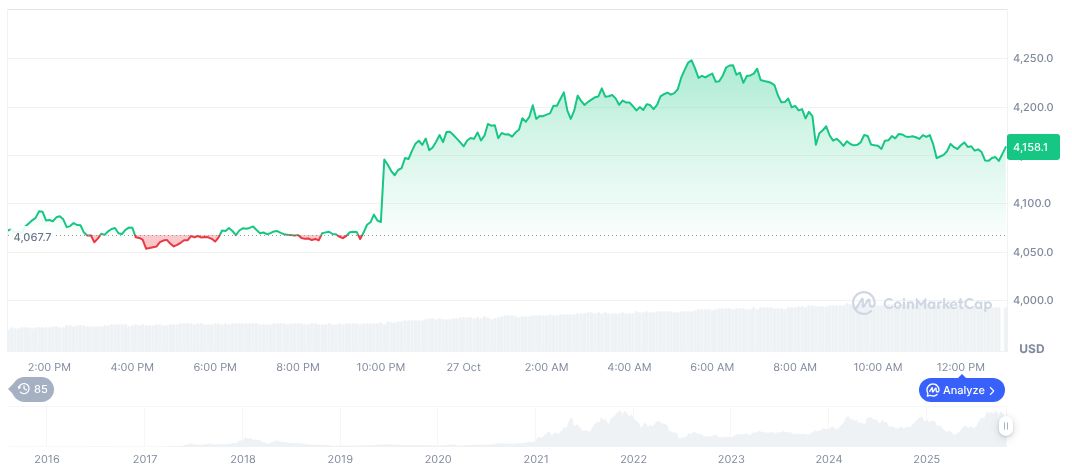
Ethereum (ETH) exhibits a price of $4,151.57 with a market cap of $501.09 billion, according to CoinMarketCap. Over the last 24 hours, ETH's trading volume indicated a 73.53% change with its price marking a 2.21% increase. The cryptocurrency’s circulation stands at 120.70 million, with a 12.94% market dominance, and recent upward movement showing a 10.34% change over 90 days, signaling potential investor confidence. Coincu's research team indicates the substantive framework between China and the U.S. might usher in smoother regulatory environments, enabling more cross-border technological exchanges. The historical trends suggest such agreements could lead to increased stability in global markets, thus bolstering investor sentiment across the cryptocurrency landscape.