


BlackRock’s iShares Bitcoin Trust has experienced its worst November on record, and the fund is now facing a six-week outflow streak, indicating a significant investor departure.
Once viewed as a crucial link between traditional finance and the cryptocurrency market, BlackRock Inc.'s iShares Bitcoin Trust (IBIT) is now signaling a decline in investor interest.
According to Bloomberg, over $2.7 billion has been withdrawn from the fund in the five weeks leading up to November 28, with an additional $113 million removed on December 4 alone.
Bitcoin's Downturn Reflects a Broader Market Shift
As Bitcoin enters a bear market and speculative retail trading diminishes, institutional investors, who were expected to provide stability, appear to be withdrawing their capital.
IBIT is currently enduring its longest period of withdrawals since its launch in January 2024, a stark contrast to the initial surge of inflows that contributed to Bitcoin's record highs earlier this year.
Despite total assets still exceeding $71 billion, the sentiment in trading circles suggests a significant shift. Data from FactSet indicates that investors pulled $2.2 billion from the ETF in the weeks preceding Thanksgiving, marking the worst monthly outflow in its history and nearly eight times the losses seen in October.
Even with Bitcoin stabilizing in recent days, the continued withdrawals suggest a decisive move towards risk-off sentiment among investors.
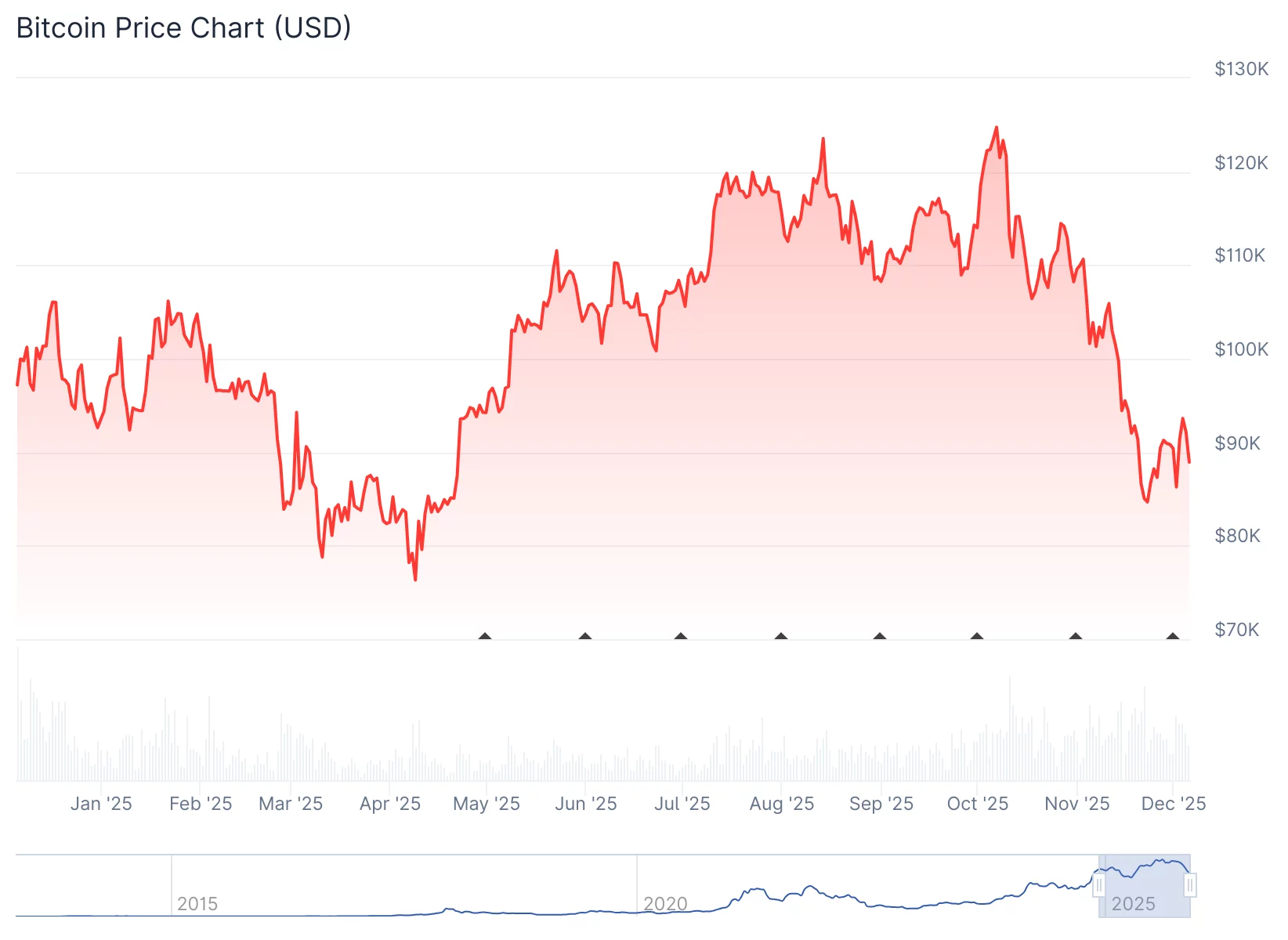
Bitcoin's performance has not helped the situation. Trading around $88,900, it has an 8.5% year-to-date loss, which stands in sharp contrast to the S&P 500's 16% rally in 2025.
Bloomberg data highlights that this is the first time since 2014 that U.S. stocks have experienced a significant rally while Bitcoin has declined.
The Political Narrative and Market Realities
The broader cryptocurrency market has lost over $1 trillion in value since a sharp liquidation event in early October initiated a prolonged downturn. Retail traders, accustomed to the significant gains of early 2024, have found it difficult to withstand the decline.
Institutional investors possess the capacity to endure market volatility, but the ongoing outflows suggest that many are choosing not to remain invested.
Furthermore, the anticipated "Trump boom" for digital assets, a narrative that many had clung to, has not materialized.
While Bitcoin briefly surpassed $126,000 earlier this year, the subsequent collapse has led the industry to re-evaluate its assumptions regarding regulatory improvements and institutional adoption.
Anthony Scaramucci, founder of SkyBridge, shared his perspective on his podcast, "The Rest Is Politics":
Trump being Trump, he launches two meme coins on the eve of the election. One for him and one for Melania, right? So meme coins again just are like gambling tokens. They have very little value. These meme coins go up in value. He takes [$500] or $600 million out for himself and his family. And these meme coins over the last seven or eight months have crashed in value… It’s just going to be a huge problem for the industry because if you have a president that’s running a self-interested memecoin, which is a worthless token, he’s susceptible to grift and graft. He’s susceptible to people buying the token and then trying to influence him. And lo and behold, Trump says, “Yeah, go buy my token or make a $5 million donation to me and I’ll meet you crypto people at my Virginia Country Club.” And so what this did actually is it soured the industry. It had the opposite effect.
More notably, Bitcoin's historical correlation with risk assets has disappeared. While AI stocks are experiencing significant growth and gold is nearing all-time highs, Bitcoin is following its own downward trend.
The current question is whether the outflows from the BlackRock ETF represent a temporary setback or an indication of a more challenging period ahead in 2026.