



Key Predictions for Bitcoin's Future
Arthur Hayes, co-founder of BitMEX, has put forth a compelling forecast for Bitcoin's trajectory in 2026. He predicts an expansion in dollar liquidity, which he believes will directly contribute to a substantial rise in Bitcoin's value. This outlook suggests significant implications for cryptocurrency investors, particularly concerning the influence of macroeconomic factors and Federal Reserve policies on digital asset valuations.
Bitcoin's Potential to Reach $500,000 by 2026
Arthur Hayes, a prominent figure in the cryptocurrency landscape, has projected a dramatic increase in Bitcoin prices by the year 2026. In a recent essay published on his Substack, Hayes articulated his belief that the Federal Reserve's anticipated balance sheet expansion, coupled with declining mortgage rates and increased bank lending, will lead to greater dollar liquidity. Consequently, Bitcoin is expected to achieve new record highs by 2026, potentially surpassing its previous valuations by a considerable margin.
The anticipated surge in Bitcoin's price is intrinsically linked to these expected shifts in dollar liquidity. These macroeconomic changes are posited to create a favorable environment for Bitcoin's appreciation, driven by the interplay of economic policies and market dynamics. The prevailing sentiment in the market aligns with the historical observation that increased liquidity generally serves as a catalyst for asset value growth.
Reactions to Hayes's prediction within the cryptocurrency community have been diverse. A segment of investors expresses optimism, drawing parallels to historical instances where Bitcoin experienced significant rallies following periods of liquidity expansion. Hayes himself conveyed strong conviction in his analysis, stating on his official Substack, "Dollar liquidity must expand for [Bitcoin] to get its groove back. Obviously, I believe it will in 2026."
Federal Reserve Actions as a Catalyst for Bitcoin's Value
Historical data indicates a strong correlation between dollar liquidity and Bitcoin's performance. Notably, a surge in dollar liquidity during 2021 was a significant factor in a substantial Bitcoin rally, lending credence to Hayes's projections for 2026.
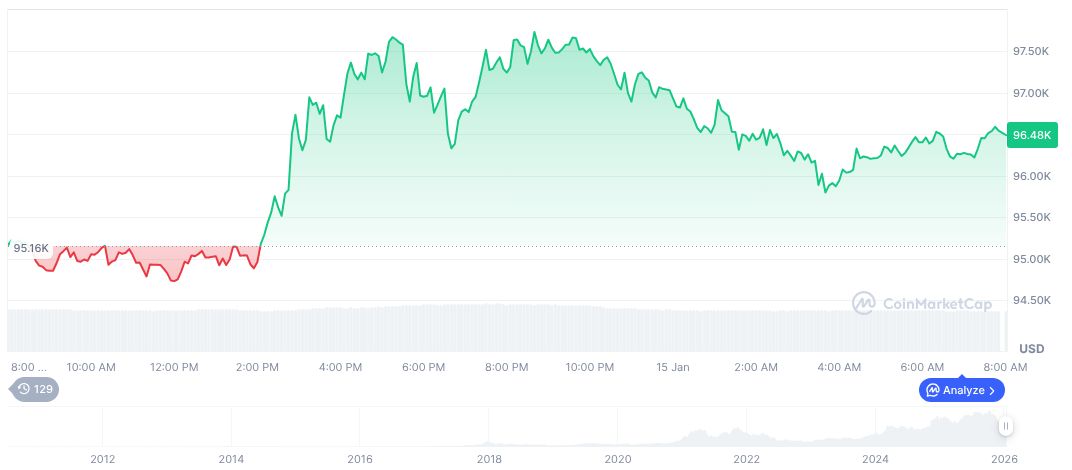
As of January 15, Bitcoin was trading at $96,779.12, with a market capitalization of $1.93 trillion and a market dominance of 59.05%. Over the preceding 24 hours, Bitcoin saw a 1.79% increase, and over the past week, it gained 7.12%. However, the asset has experienced a 7.53% decrease within the last 90 days, reflecting the inherent volatility characteristic of the cryptocurrency market.
The research team at Coincu observes that the established relationship between liquidity and Bitcoin's value suggests that anticipated actions by the Federal Reserve could exert a positive influence on cryptocurrency markets. This perspective is consistent with previous occurrences where the debasement of fiat currency led to an increase in Bitcoin's price, offering a hedge against inflationary pressures.