


Corporate Buyers Absorb Supply Faster Than Miners Produce It
Bitcoin treasuries continued to buy Bitcoin despite significant price volatility. Recent data indicates that corporate wallets are accumulating the cryptocurrency at a pace that outstrips its production by miners. Glassnode reports that public and private companies have collectively added a net total of 260,000 BTC over the past six months. During the same period, miners produced approximately 82,000 BTC. This trend underscores the growing influence of Bitcoin treasuries in reshaping the market's supply dynamics, with corporate buyers acquiring more than three times the new Bitcoin supply generated by miners.
Bitcoin Treasuries Reach 4.06 Million BTC Amidst Structured Holdings Growth
Current estimates suggest that monthly net inflows into Bitcoin treasuries are around 43,000 BTC, a value approaching $25 billion at current market prices. Over a six-month span, company-held Bitcoin treasuries have seen a substantial increase, rising from approximately 854,000 BTC to about 1.11 million BTC. Structured entities, encompassing various treasury categories, now collectively hold an estimated 4.06 million BTC. Exchange-Traded Funds (ETFs) and other funds represent the largest portion of these holdings, accounting for around 1.49 million BTC.
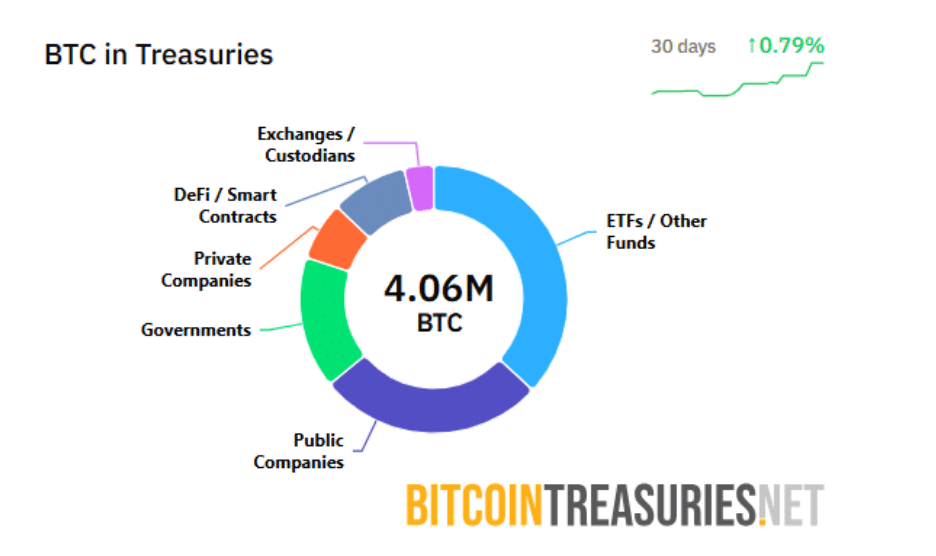
Public companies hold the second-largest share, with holdings exceeding 1.1 million BTC. The remaining Bitcoin is held by governments, private firms, DeFi contracts, and custodians. Bitcoin treasuries are emerging as a significant force in the market, with companies increasingly moving BTC from exchanges into long-term custody solutions. This action effectively reduces liquid circulation and contributes to supply tightness, which can amplify price movements in both directions. Furthermore, long-term holders may exhibit a reduced tendency to sell during periods of market panic.
Bitcoin Treasuries Outpace Miner Supply Significantly
Bitcoin miners contribute approximately 450 BTC per day to the circulating supply, equating to roughly 13,500 BTC per month. Bitcoin treasuries, however, are absorbing a substantially larger amount on a net basis. The disparity observed over the last six months is significant enough to indicate a structural shift in the market.
Glassnode data reveals a net addition of 260,000 BTC by corporate holders, while miner output during the same period was close to 82,000 BTC. This data suggests that demand for Bitcoin is not only robust but also remarkably consistent, positioning Bitcoin treasuries as a steady and influential buyer segment.

Corporate Holdings Expansion Reaches Record Pace
The accumulation of Bitcoin by companies has been particularly rapid, with corporate-held treasuries increasing from approximately 854,000 BTC to around 1.11 million BTC. This represents an increase of roughly 256,000 BTC within a six-month timeframe, a growth rate that few periods in history can match. This trend provides strong evidence that Bitcoin is increasingly being recognized and utilized as a balance-sheet reserve asset.
This sustained accumulation trend has significant implications for market depth. With fewer Bitcoin coins readily available for active trading, the market's reaction to demand spikes can become more pronounced. This also heightens the potential for rapid price movements during sudden selling events.
Strategy Leads Bitcoin Treasuries with Dominant Share
Among corporate Bitcoin treasuries, Strategy remains the largest holder, with holdings reported at 687,410 BTC. This figure represents nearly 60% of the Bitcoin held by public and private companies collectively. The substantial difference in scale between Strategy's holdings and those of other corporate entities is notable.
Strategy has consistently funded its Bitcoin purchases through equity issuance and convertible debt. This financial strategy has enabled continuous buying irrespective of short-term market fluctuations. Consequently, Strategy's approach to Bitcoin treasury management has become a key benchmark for corporate adoption of the cryptocurrency.
MARA Builds Treasury Strength Through Mining Retention
MARA Holdings ranks as the second-largest corporate Bitcoin treasury, holding 53,250 BTC. In contrast to Strategy, MARA has primarily acquired its Bitcoin through its mining operations. The company has increasingly opted to retain its mined output rather than selling it, a strategy that reduces sell pressure originating from miner treasuries.
Miner retention has become a critical variable in the Bitcoin market. When miners sell less of their newly mined Bitcoin, the available supply tightens further, amplifying the impact of corporate accumulation. This behavior also suggests that miners may be adopting a more long-term holding strategy, similar to other institutional investors.
Twenty One Capital Emerges as a Top Corporate Holder
Twenty One Capital has secured the third position among corporate Bitcoin holders, with 43,514 BTC. The company commenced its Bitcoin accumulation strategy upon its launch in December 2025, following its merger with Cantor Equity Partners. The rapid ascent of Twenty One Capital into the top tier of corporate holders indicates an aggressive entry by structured firms into the Bitcoin treasury space.
The emergence of new entrants like Twenty One Capital intensifies competition within the Bitcoin treasury market and broadens institutional participation. A larger base of corporate buyers can distribute demand across numerous balance sheets, potentially reducing the reliance on any single dominant firm for treasury buying activity.
Metaplanet Signals Growing Global Demand for Bitcoin Treasuries
Metaplanet, a company based in Japan, holds 35,102 BTC and began accumulating Bitcoin in 2024. The firm has articulated its strategy as a means of inflation protection and long-term exposure to the asset. Metaplanet's holdings demonstrate that the trend of Bitcoin treasury adoption is not confined to U.S. markets, indicating growing global demand.
International treasury adoption expands the buyer base for Bitcoin and can create distinct regional demand cycles. In some regions, Bitcoin is viewed primarily as a hedge against currency devaluation, while in others, it is considered a growth asset. Both motivations contribute to the ongoing expansion of Bitcoin treasuries worldwide.
Structured Entities Hold 4.06 Million BTC Across Major Categories
Across various treasury categories, structured entities now hold an estimated 4.06 million BTC. ETFs and funds account for approximately 1.49 million BTC of this total. Public companies hold over 1.1 million BTC, with governments, private firms, DeFi contracts, and custodians holding the remainder.
This distribution of holdings has implications for supply dynamics. ETFs, for instance, can experience more rapid inflows and outflows compared to corporate treasuries, which typically exhibit slower movement. Government and custodian holdings can vary based on policy decisions and liquidity requirements. The broader trend of institutional asset holding is reflected in the diverse nature of Bitcoin treasuries.
Supply Tightening Could Influence Volatility in 2026
The continuous accumulation of Bitcoin by corporate treasuries is effectively removing BTC from liquid circulation. This trend could establish stronger support levels during market downturns and potentially increase upward price pressure when demand surges rapidly. With a reduced supply of liquid Bitcoin, the price may react more swiftly to incoming demand.
Some market analysts suggest that volatility could decrease over time, positing that institutional holders are less inclined to sell during periods of market panic. If this pattern persists, Bitcoin treasuries might contribute to stabilizing market behavior. This ongoing trend also reinforces Bitcoin's position as a significant institutional asset.
Conclusion
Over the last six months, Bitcoin treasuries have added a net 260,000 BTC, significantly exceeding the approximately 82,000 BTC produced by miners during the same period. Company-held Bitcoin balances have grown from around 854,000 BTC to roughly 1.11 million BTC.
Strategy continues to lead corporate holdings with 687,410 BTC, followed by MARA, Twenty One Capital, and Metaplanet. If this buying trend persists, Bitcoin treasuries are likely to continue tightening liquid supply and influencing market structure into 2026.
Appendix: Glossary of Key Terms
Bitcoin Treasuries: Bitcoin held by companies as a reserve asset on their balance sheets.
Net Inflow: The net amount of Bitcoin added to a wallet or entity after accounting for both purchases and sales over a specific period.
Miner Supply: New Bitcoin entering circulation as rewards for miners who validate transactions on the blockchain.
Structured Entities: Organizations such as ETFs, investment funds, corporations, or other institutions that hold Bitcoin in a regulated or formalized manner.
Liquid Supply: The amount of Bitcoin readily available for trading on exchanges and in various market platforms.
Open Interest: The total number of active futures contracts that remain open and have not been settled in the derivatives markets.
Convertible Debt: A type of debt that can be converted into shares of the issuing company's stock, often used as a method for raising capital.
Custodian: A regulated service provider responsible for securely storing digital assets on behalf of institutions.
Frequently Asked Questions About Bitcoin Treasuries
1- What are Bitcoin treasuries?
Bitcoin treasuries refer to Bitcoin holdings maintained by companies and structured entities as part of their reserve asset strategies.
2- How much BTC did companies add recently?
Based on data from Glassnode, companies added a net total of 260,000 BTC over the past six months.
3- Who holds the most BTC among corporate treasuries?
Strategy is the largest holder among corporate treasuries, with 687,410 BTC.
4- Why do Bitcoin treasuries impact price?
Bitcoin treasuries impact price by reducing the available liquid supply of Bitcoin and can contribute to sustained demand pressure, potentially influencing market value.