


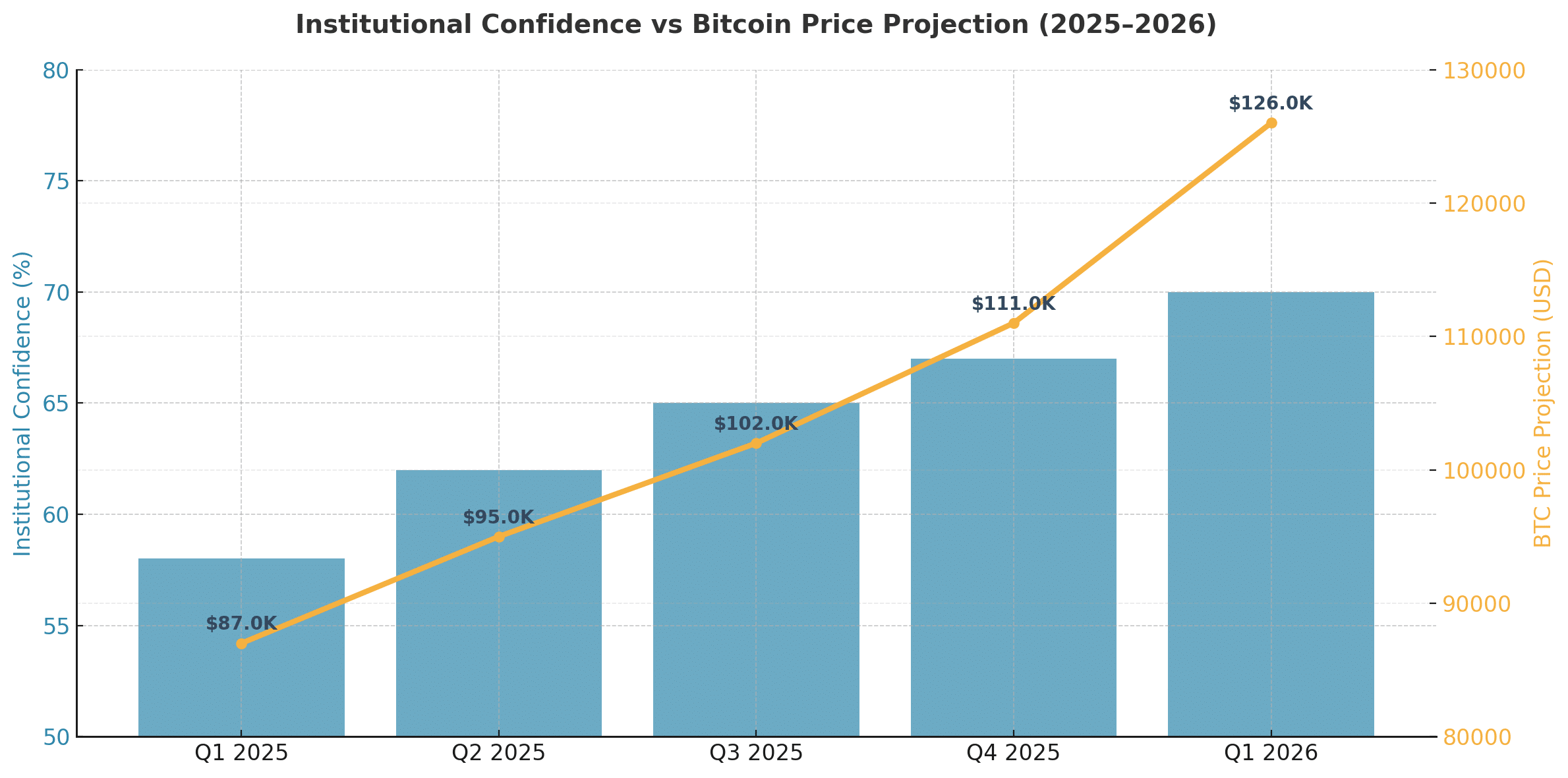
A recent survey indicates that 67 percent of institutional investors anticipate Bitcoin's value to increase in the next three to six months, suggesting confidence in its medium-term trend. Among 124 respondents, a notable divide exists: 45% of institutions believe the market is nearing the end of a bull run, while only 27% of non-institutional respondents share this view. This discrepancy suggests that various institutional players may be approaching the opportunity from different perspectives. The institutional outlook for Bitcoin remains bullish, driven by macro and liquidity catalysts rather than speculation alone. This institutional appetite is reportedly based on the liquidity of the crypto market.
Institutional Bullish Outlook for Bitcoin: Q1 2026 Update
Bitcoin is currently valued at approximately $111,211 USD, according to finance data. Other sources provide recent quotes ranging from $110,700 to $112,500. With its price firmly above six figures, the institutional bullish narrative for Bitcoin is being constructed on the foundation of its high price, strong network data, and macro liquidity.
Why the Institutional Bull Case for Bitcoin Has Strengthened
The institutional long-term thesis for Bitcoin is supported by several key pillars. Corporate treasuries and digital asset holdings continue to grow, which bolsters both fund supply headwinds and demand. The expectation of further interest rate cuts by the Federal Reserve, coupled with a substantial amount of money market funds on the sidelines, is likely to drive new capital into risk assets like Bitcoin. On-chain metrics, such as exchange outflows, provide evidence of accumulation rather than distribution.
“Right now, the structurally bullish institutional backdrop for Bitcoin is inherently structural demand and growing macro factors.”
These factors include resilient liquidity conditions, a strong macro backdrop, and supportive regulatory dynamics, according to Coinbase. These elements underlie what the firm sees as Bitcoin's near-term upside potential.
Price Prediction Table for Bitcoin Institutional Investor Sentiment 2026
| Scenario | Q4 2025 Range | Q1 2026 Range | Key Imperatives |
| Bear | $85k–$107k | $75k–$105k | Growth shock, USD strength, ETF outflows |
| Base | $107k–$123k | $105k–$130k | Moderate Fed easing, steady ETF inflows, accumulation |
| Bull | $123k–$139k | $130k–$150k+ | Clear policy support, accelerating treasury buys, liquidity release |
This structured price forecast addresses the "Bitcoin mid-term price prediction Q4 2025" scenario and aligns with the institutional bullish outlook for Bitcoin, while avoiding unrealistic hype.
On-Chain Signals and Institutional Behavior
The institutional bullish narrative for Bitcoin is further strengthened by on-chain flows and treasury activity. Public companies collectively own over 1 million BTC, and the mining network hashrate persists at high levels, implying structural support. Buy-the-dip behavior also continues within corporate treasuries, despite pockets of market corrections. When institutions perceive that the institutional bull thesis for Bitcoin remains intact, their positioning may evolve from opportunistic to strategic.
Threats to the Corporate Bull Case for Bitcoin
Despite institutional bullish sentiments towards Bitcoin, caution is warranted. Key risk factors include:
- •A geopolitical shock or trade wars could trigger risk-off flows and pressure on Bitcoin.
- •An unexpected hawkish shift by the Federal Reserve or other monetary authorities could distort anticipated liquidity tailwinds.
- •Technical breakdowns: If Bitcoin falls below its 200-day moving average or breaks through key support around $103k, momentum could reverse.
While the institutional enthusiasm for Bitcoin provides a basis for optimism, remaining observant is crucial.
Bullish Sentiment for Bitcoin as an Institutional Investment Grows In Credibility
Institutional bias towards Bitcoin has credible support from survey data and macro metrics. With BTC currently trading at approximately $111k USD and structural supports remaining intact, the argument for higher prices through Q1 2026 remains strong in both base and bull scenarios. The overall institutional view is bullish for Bitcoin, indicating that many large players anticipate significant upside. As market dynamics evolve, monitoring institutional behavior, macro flows, and on-chain indicators will be important for understanding the unfolding of the institutionally bullish perspective on Bitcoin.
Summary
According to Coinbase's most recent survey, 67% of institutional investors view Bitcoin's prospects positively for the next six years. This bullish sentiment is driven by improved liquidity, regulatory clarity, and favorable macroeconomic factors. Institutions continue to accumulate Bitcoin, reinforcing long-term confidence and market stability. Experts project Bitcoin's price to range between $123,000 and $150,000 by Q1 2026. Growth catalysts include corporate treasury investments, ETF inflows, and robust on-chain fundamentals, suggesting the bull market may continue to expand.
Glossary of Essential Terms
1. Institutional Investors: Financial organizations, such as mutual funds and pension plans, that manage pools of assets. Their involvement is often seen as a sign of market maturation and confidence in Bitcoin.
2. Coinbase Institutional Survey: A recurring study conducted by Coinbase that tracks the sentiment of professional investors regarding current market conditions, offering insights into the attitudes of institutional holders toward Bitcoin's price potential and market confidence.
3. Bitcoin Price Forecast: A benchmarked score, expressed as an alternative to volatile price figures. Changes in macroeconomic trends, adoption rates, Bitcoin usage, liquidity rates, and institutional money participation can influence its potential value.
4. Market Liquidity: Refers to how easily Bitcoin can be traded without causing significant price movements. Higher liquidity indicates a healthier market and favorable trading conditions for institutions.
5. Exchange-Traded Funds (ETFs): Exchange-traded products that allow traditional investors to gain exposure to Bitcoin without directly buying or holding it. Institutional ETF inflows are considered highly bullish for long-term price growth.
6. Hashrate: The total computational power dedicated to mining and securing the Bitcoin network. An increasing hashrate signifies a secure network and miners' confidence in Bitcoin's long-term economic viability.
7. Macro Tailwinds: Macroeconomic narratives, such as interest rate cuts, regulatory certainty, or fiscal stimulus, that indirectly drive demand for Bitcoin by improving overall global market liquidity and encouraging risk-on behavior.
8. MiCA Regulation: The Market in Crypto-Assets (MiCA) framework by the European Union, designed to harmonize crypto compliance, enhance transparency, and provide legal certainty for institutional investors operating within the digital asset space.
Frequently Asked Questions About Institutional Bullish Outlook for Bitcoin
1. What does institution-man bullish Bitcoin price action mean?
This refers to the increasing conviction among major financial institutions that Bitcoin will experience significant appreciation and adoption between now and 2026, driven by favorable macro conditions and regulatory developments.
2. How would institutional bullishness impact the 2026 price prediction for Bitcoin?
Institutional accumulation tends to reduce market volatility, enhance liquidity, and exert upward pressure on prices. This aligns with predictions of Bitcoin trading between $123k and $150k by early 2026.
3. Is institutional Bitcoin investment safe and legal?
Yes, through regulated custodians and compliance frameworks (such as MiCA or U.S. ETF approvals), institutional Bitcoin holdings are subject to increased security, audit, and transparency standards.
4. Which changes or events will impact institutional Bitcoin sentiment going forward?
Future macroeconomic developments, the global rollout of ETFs, inspired regulations, and next-generation blockchain scaling solutions are anticipated to sustain the trend of institutional involvement and market stability through 2026.