



Market Overview
The cryptocurrency market began the new week under significant selling pressure, impacting major digital assets. Ethereum (ETH) experienced a notable decline, falling below the $2,800 level to trade at $2,743, a loss of 9.90% in the last 24 hours, according to Binance data. Bitcoin (BTC) also saw a substantial pullback, dropping below the $84,000 threshold to $84,113, marking an 8.03% daily decrease.
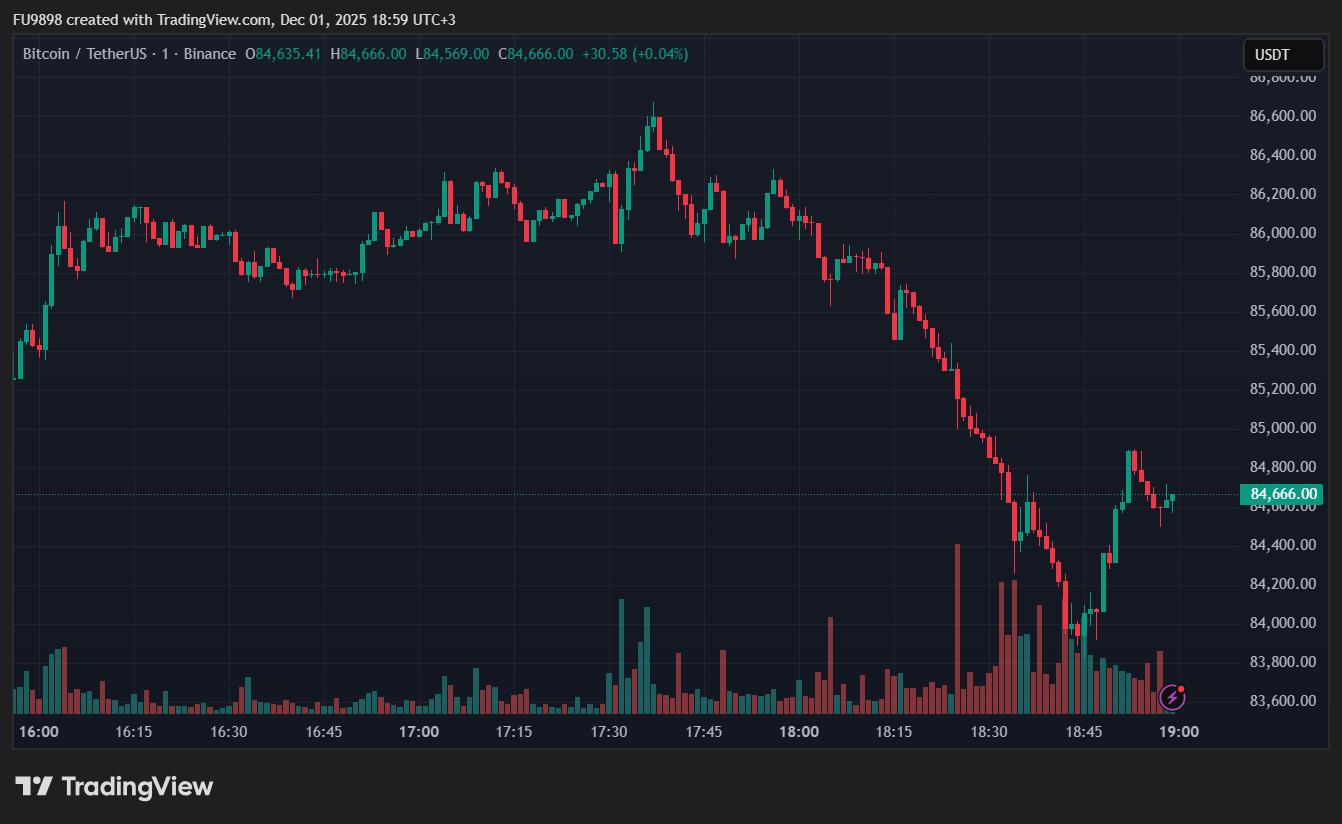
This sharp decline in both prominent cryptocurrencies triggered significant chain liquidations in leveraged markets, further amplifying volatility across the digital asset space.
Liquidation Data and Impact
Total liquidations in the last 24 hours surged to $934.64 million, representing one of the highest figures recorded recently. The vast majority of these liquidations, $858.45 million, were long positions, while $76.18 million were short positions.
The impact of the selling pressure was evident even in shorter timeframes. Within the last hour, the total value of liquidated positions reached $145.79 million. Over a four-hour period, this figure climbed to $326.24 million, and within a 12-hour window, it amounted to $399.27 million. Bitcoin led the liquidation figures with $375.47 million. Other significant liquidations included Ethereum with $223.11 million, Solana with $46.36 million, and Zcash with $25.69 million.
Performance of Other Major Altcoins
The negative trend extended to other major cryptocurrencies. XRP fell to $2.01, experiencing an 8.04% drop in the last 24 hours. Binance Coin (BNB) also succumbed to the selling pressure, declining to $813, a loss of 8.94%. Solana's value decreased by 9.23%, bringing its price to $125. Dogecoin saw a drop of over 10%, trading at $0.1342, while Cardano (ADA) fell 10.72% to $0.3774.
Seasonal Trends vs. Current Market Drivers
Historically, Bitcoin has shown a tendency to rise in December, with an average increase of 9.7%, making it its third-strongest monthly performance of the year. The strongest month on record is October, with an average increase of 16.6%, while September has been the weakest, with a 3.5% decline. However, current market analysis suggests a deviation from traditional seasonality. Experts indicate that Bitcoin's strong correlation with stock markets means that shifts in overall risk appetite are now the primary drivers of its price behavior, rather than historical seasonal patterns.
Expert Analysis on Market Sentiment
Kathleen Brooks, research director at XTB, posits that Bitcoin is currently acting as a leading indicator for overall risk appetite. She suggests that the recent decline in the crypto market might have contributed to a weaker start for stocks at the beginning of the month. Brooks also highlighted that the sharp decrease in volatility is contributing to investor nervousness. The VIX index falling below its 12-month average is fueling a sense of uncertainty as the year draws to a close. Furthermore, the outlook for CME Bitcoin futures is weakening, with the premium on three-month Bitcoin contracts reaching its lowest level in at least a year, indicating a diminished appetite for long-term price appreciation among investors.
Jefferies strategist Mohit Kumar offers a different perspective, stating that negative developments affecting various cryptocurrencies have collectively contributed to the increased pressure on Bitcoin.
Specific Negative Catalysts
Last week, S&P Global downgraded Tether's stock price, citing an increasing proportion of high-risk assets within its reserves and "persistent gaps" in transparency. Despite Tether's strong rejection of this assessment, it added further pressure to the cryptocurrency market.
Additionally, Phong Le, CEO of Strategy, a firm holding a significant amount of Bitcoin, indicated that the company might consider selling its Bitcoin holdings if its mNAV (market net asset value) metric falls below 1. Currently, the mNAV stands at 1.19. However, Strategy shares have experienced a substantial decline of 60% over the past year, while Bitcoin has seen a more modest decrease of 13% during the same period.
This significant downturn in Strategy's stock price also raises the risk of the company being removed from certain stock indices. MSCI is scheduled to complete its assessment this month regarding the potential removal of companies whose total assets are more than 50% invested in digital assets from benchmark indices. Such a decision could exert additional downward pressure on both Strategy's stock and its mNAV balance.