
Navigating Crypto News

CoinFeather
Navigating Crypto News

Quick market read from this story
Bitcoin's historical seasonality is highly conditional on the year's current state (YTD performance and regime), suggesting that simple calendar averages are unreliable trading signals without this context.
The year 2026 has deviated from typical seasonal patterns, particularly with a negative January followed by a negative February, placing it in a 'repair-or-failure' state that requires Q2 performance to validate any potential second-half rally.
A strong Q1 performance historically improves the odds of a positive full-year return but often leads to a weaker Q2, indicating that while the overall trend may be constructive, tactical entry points can become challenging.
The critical test for 2026 lies in Q2; if Bitcoin cannot achieve a significant rebound by June, the market's optimistic seasonal narratives for the latter half of the year become less credible, shifting the focus to downside risk.
Deep Dive
Bitcoin's historical seasonality, often cited through simple calendar averages, can be misleading. A deeper analysis reveals that the effectiveness of seasonal trends is heavily dependent on the current market regime and the year's path, rather than just the month itself. Averages can obscure crucial details like median returns, win rates, and the distribution of outcomes, leading to a flawed understanding of potential edges.
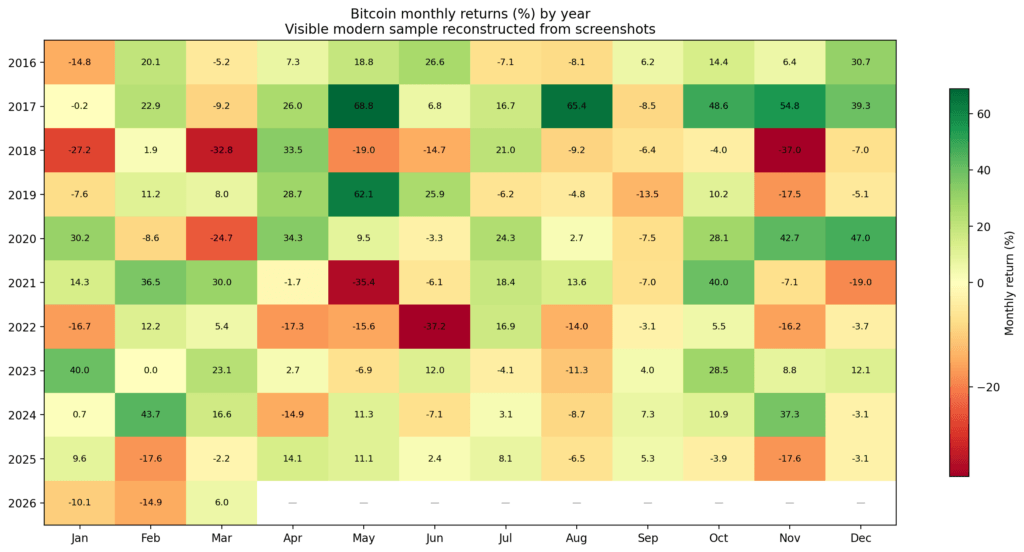
While average monthly returns might suggest consistent bullish periods for Bitcoin, examining median returns and win rates paints a different picture. Months like August, December, and May, despite positive averages, show significant variance, negative medians, or low win rates, indicating that these averages are often driven by a few outlier events rather than consistent performance. Months like October and July show more consistent positive performance across averages, medians, and win rates, making them more reliable seasonal indicators.
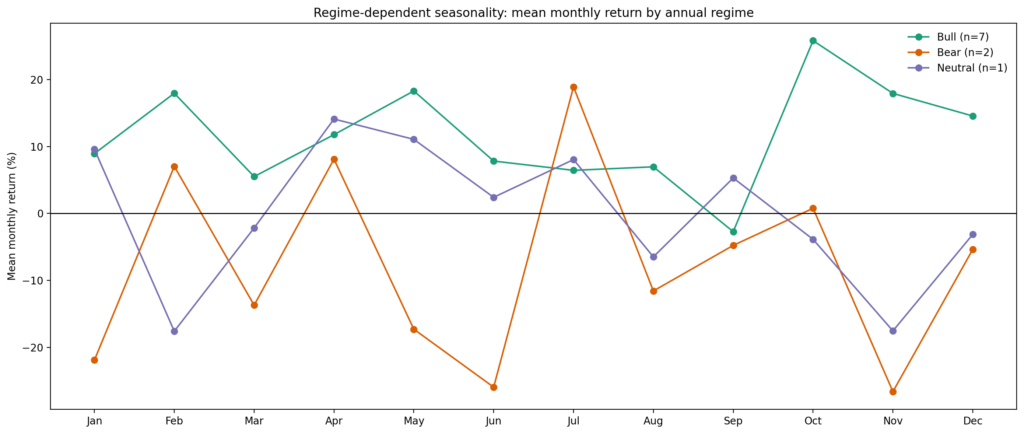
Splitting years into bull (above 50% annual return), bear (below -20%), and neutral regimes reveals that seasonality is highly dependent on the broader market state. Many months flip their seasonal sign based on whether the year is bullish or bearish. This suggests seasonality is a consequence of market state, not an independent driver. Only a few months, like July and to a lesser extent April, show resilience across different regimes, while September consistently appears weak.
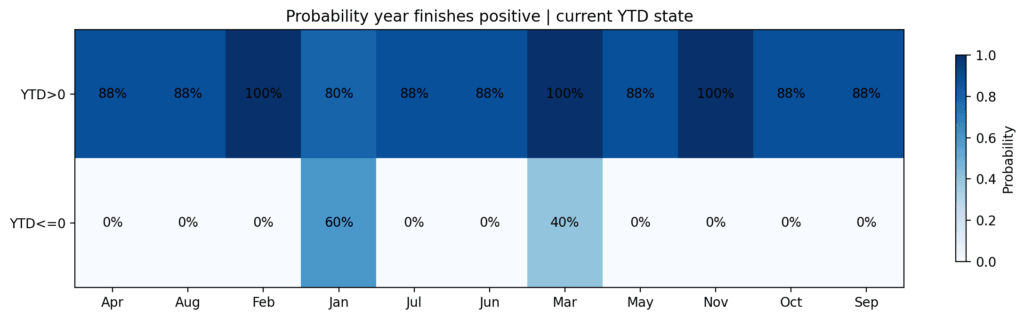
The most significant signals come from path dependency rather than calendar averages. If Bitcoin is positive year-to-date (YTD) by late Q1 (after February), it has historically finished the year positive. Conversely, if it's negative YTD by then, positive year-end finishes are rare. This highlights that the year's trajectory, particularly its performance in the first quarter, is a critical filter for seasonal expectations. Simple month-to-month momentum shows little predictive power, with similar probabilities of positive outcomes following both up and down months.
A strong first quarter (Q1) above 20% has historically led to positive year-end returns, but it often results in a weaker second quarter (Q2) as gains are pulled forward. This indicates that while a strong start improves the overall year's outlook, it can create tactical challenges for entry in the subsequent quarter. The critical decision point appears to be midyear (June). Years with first-half returns at or below zero have never finished positive, while those with positive first-half returns have a high probability of ending the year positively. For years starting negatively, a Q2 rebound exceeding 20% is crucial for a positive year-end outcome.
The year 2026 presents a unique case, deviating from typical seasonal patterns. It experienced a negative January followed by a negative February, a sequence not seen in the modern sample. With Q1 ending down approximately 19%, 2026 is in a 'repair-or-failure' state, similar to years like 2016, 2018, 2022, and 2025. The key question for 2026 is whether Q2 can achieve a significant recovery (over 20% compound growth) to move the year out of this damaged state. Without such repair by June, optimistic seasonal narratives for the second half become less credible. The potential ceiling for Bitcoin in 2026 is currently estimated around $88,000.
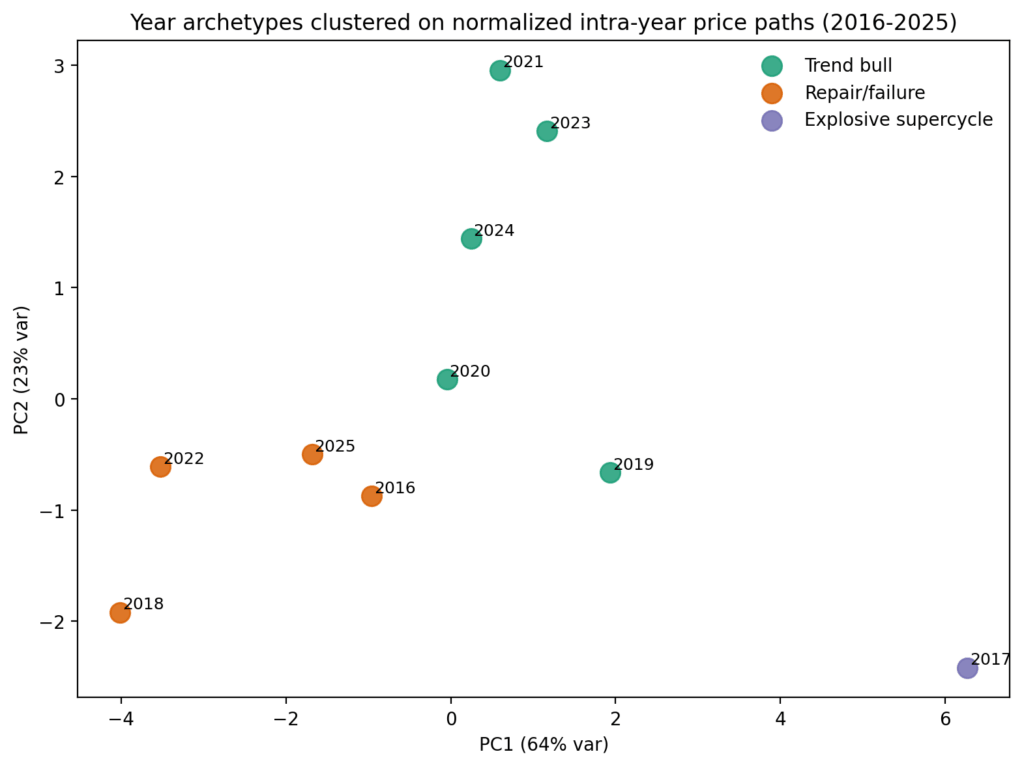
The true edge in Bitcoin seasonality lies not in memorizing calendar patterns but in understanding their conditionality. Seasonality is most valuable when a month shows strong historical distribution and the year enters it from a healthy state. For damaged years, the ability of Q2 to repair the YTD trajectory is paramount. Relying on regime-blind averages or outlier-driven means is illusory. For 2026, the market must earn a better seasonal profile through demonstrable repair by midyear; otherwise, the calendar's optimistic signals should be viewed with skepticism.
Source, catalyst, and sector overlap from the latest feed.
Bitcoin's technical structure has deteriorated, with key support levels broken, suggesting a potential decline to $61,700 if macro pressures persist. Elevated Treasury yields and Middle East risk are creating a challenging macro backdrop, increasing the downside pressure on Bitcoin. Donald Trump's social media posts represent a significant political catalyst that could influence Bitcoin's price direction over the weekend, with de-escalation potentially leading to a relief rally and hardened rhetoric exacerbating losses. The market is currently trading based on the potential for further downside rather than rebuilding previous support, making $66,900 and $68,000 critical reclaim levels for any bullish recovery.
David Sacks leaves office with wins for crypto infrastructure, while Bitcoin holders are still waiting David Sacks is out of the formal White House crypto czar role after exhausting the 130-day limit attached to his special government employee status. The change closes the clearest window for a scorecard. The record is substantial, yet it falls […] The post White House crypto czar leaves office after securing crypto wins for banks and institutions instead of Bitcoin appeared first on CryptoSlate.
The partnership between Better Home & Finance and Coinbase introduces a novel way for homebuyers to leverage Bitcoin and USDC as collateral for down payment loans, potentially increasing demand for these assets by linking them to traditional real estate finance. This development signifies a growing integration of digital assets into mainstream financial services, offering a solution for individuals holding crypto wealth but lacking immediate liquidity for home purchases, thereby expanding the addressable market for both crypto and real estate. While the product aims to avoid liquidation triggers based solely on market volatility, the reliance on Fannie Mae guidelines and the inherent risks of collateralized loans in a fluctuating market present potential challenges and regulatory scrutiny. The initiative could serve as a blueprint for future TradFi integrations, with plans to expand eligible collateral to tokenized equities and fixed income, signaling a broader trend towards bridging on-chain and off-chain asset classes.
Bitcoin's recent price drop to near $65,000 is primarily driven by macroeconomic factors, specifically rising oil prices and Treasury yields due to geopolitical tensions, indicating it's still trading as a risk-on asset rather than a safe haven. The pause in geopolitical escalation did not alleviate inflation concerns, leading to expectations of tighter financial conditions and a stronger dollar, which collectively pressure risk assets like Bitcoin. Uneven inflows into US spot Bitcoin ETFs, coupled with a large options expiry, exacerbated the price decline, highlighting that institutional demand is not yet a consistent buffer against macro headwinds. Near-term price action for Bitcoin is likely to remain range-bound between $65,000 and $72,000, with significant directional breakouts requiring a broader alignment of macro variables rather than isolated events.
The confluence of a significant macro selloff driven by oil shocks and rising Treasury yields, coupled with a substantial $14.1 billion Bitcoin options expiry on Deribit, created a potent bearish catalyst that pressured prices lower. The specific settlement mechanics of Deribit's options, particularly the 30-minute time-weighted average pricing window, amplified short-term price movements as dealers hedged put positions into a falling market. Despite the large options expiry, the 'max pain' price point of $75,000 was significantly distant from the current spot price, suggesting that the market's immediate reaction was driven more by macro pressures and hedging flows than by a direct push towards a specific expiry-related price target. The article highlights that the macro environment's negative sentiment, characterized by reduced rate-cut expectations and a risk-off rotation into money market funds, preceded and exacerbated the impact of the options expiry, indicating that the expiry acted as an accelerant rather than the sole cause of the price decline.
Solana's market structure shows continued weakness with $14M in liquidations, indicating that bullish sentiment is being punished and suggesting potential for further downside. Technical analysis points to a distribution phase and a rounded top pattern, with key resistance at $100-$110 and potential targets below $50 if the $80 level breaks. Elliott Wave analysis suggests a strong wave three decline is underway, with immediate targets between $78-$72, reinforcing a bearish outlook for Solana in the short to medium term.
Cardano's Midnight network is positioning itself as a key infrastructure layer for RWA tokenization, evidenced by a significant £250 million deal with Monument Bank, suggesting a strategic shift towards institutional adoption. The integration of Midnight with Cardano's core architecture implies that growth in the new network could bolster the entire ecosystem rather than fragment it, potentially driving demand for ADA if institutional use cases scale. Despite positive developments for Midnight, investor sentiment remains divided, with ongoing debate about capital allocation between ADA and the NIGHT token, reflecting uncertainty about immediate repricing catalysts. Technical indicators for both NIGHT and ADA suggest a consolidation phase, indicating that current price action is not yet reflecting the potential long-term implications of Midnight's institutional partnerships and tokenomics.
Bitcoin options market sentiment has turned decidedly bearish, with traders pricing in a 53% chance of BTC falling below $66,000 by April 24, driven by macroeconomic fears and geopolitical uncertainty. The departure of David Sacks from his crypto and AI czar role and the lack of a clear US Strategic Bitcoin Reserve plan are contributing to investor doubts and underperformance relative to traditional markets. Friday's significant Bitcoin options expiry saw a large volume of call options become worthless, favoring bearish strategies and indicating a reluctance among traders to hold risk over the weekend due to potential geopolitical escalations.
Evernorth's upcoming XRPL lending protocol, leveraging XLS66 for automated interest and collateral enforcement, signals a significant DeFi development on Layer 1, potentially unlocking idle XRP for institutional yield generation. The testing of Ripple Payment Direct (RPD) using stablecoins on XRPL indicates a strategic move towards broader institutional adoption, prioritizing stable settlement over XRP as a bridge asset for payments. Despite positive protocol developments, the zero net inflows into XRP ETFs suggest a current market sentiment shift away from direct XRP investment vehicles, potentially due to broader market bearishness or a lack of fresh catalysts.
Falling Ethereum exchange reserves suggest a tightening supply, which is typically a bullish signal for asset price if demand remains constant. Despite potential supply tightening, Ethereum's price action remains weak, with rejections at key resistance levels indicating bearish short-term momentum. Traders are closely watching the $1,750 support level, as a break below could lead to further downside towards $1,400-$1,500, while reclaiming $2,400 is needed for a bullish reversal.
Live Feed
Loading the broader stream in the same flow as the homepage feed.
Coca-Cola's CEO transition, driven by AI adoption, signals a strategic pivot towards technological integration for future growth. The appointment of Henrique Braun as CEO indicates a focus on accelerating AI implementation across global operations, presenting both opportunities and complexities. Despite leadership changes, Coca-Cola's strong financial performance and stock appreciation provide a stable foundation for its AI-centric transformation.
The upcoming release of the CLARITY Act's stablecoin yield text signals a critical juncture for regulatory clarity, potentially impacting how stablecoin rewards are structured and perceived by the market. Industry pushback, exemplified by Coinbase's counterproposal, indicates ongoing negotiation over stablecoin reward parameters, suggesting that the final rules may differ from initial proposals and could influence user incentives. The departure of David Sacks from his White House AI and crypto role during this key legislative period may shift negotiation dynamics, potentially leading to a more direct focus on lawmakers and agency officials. With parallel regulatory actions from agencies like the OCC, SEC, and CFTC, the CLARITY Act's release could integrate into a broader, evolving framework for stablecoin implementation, affecting market participants across multiple fronts.

Circle's stock experienced a significant drop due to fears surrounding the CLARITY Act's potential impact on stablecoin rewards, though analysts suggest the sell-off may be overdone as the legislation primarily targets user-facing yield distribution rather than issuer reserve income. Institutional adoption of stablecoins is progressing in Canada, with Deloitte and Stablecorp integrating QCAD into financial systems, indicating a move towards broader integration of digital assets into traditional finance ahead of regulatory clarity. Prediction markets like Polymarket are implementing stricter rules and enhanced surveillance to combat insider trading and manipulation concerns, reflecting increased regulatory scrutiny on these platforms. AI agents, potentially facilitated by protocols like Stripe's MPP, could finally unlock the long-sought micropayments economy by automating transactions, which may increase demand for stablecoins as a low-cost payment solution.
Bitcoin's price action is being analyzed through two distinct lenses: historical support levels tied to holder cost basis and a short-term rising wedge pattern, suggesting potential accumulation zones if significant pullbacks occur. Analysts are monitoring key support bands around $48,387 and $36,657, historically significant for long-term holders, as potential dip-buying opportunities if Bitcoin experiences deeper corrections. A short-term bullish setup is identified within a rising wedge, with traders watching the lower boundary for favorable risk-reward entry points, contingent on the overall bullish structure remaining intact. Overhead resistance levels, including the 50, 100, and 200-day moving averages, are highlighted as potential hurdles for Bitcoin's upward momentum, with liquidity clusters above and below current price indicating potential volatility.
Bitcoin's recent dip below $66K, coupled with significant long liquidations and ETF outflows, suggests a bearish short-term sentiment driven by macroeconomic fears and derivative expirations. The article highlights potential buying opportunities as analysts predict further downside towards $52.5K or $50K, framing the current sell-off as a precursor to a potential accumulation phase. Geopolitical tensions and rising oil prices are identified as key drivers of inflation fears, impacting traditional assets and indirectly pressuring Bitcoin due to its correlation with risk assets and Fed policy uncertainty.

Morgan Stanley's entry into the spot bitcoin ETF market with a 14 basis point fee signals aggressive fee competition, potentially driving down costs for investors and attracting significant inflows. The bank's substantial wealth management arm could shift billions in assets by leveraging its extensive advisor network, impacting existing ETF providers. This move by a major U.S. bank to offer a spot bitcoin ETF directly, with a competitive fee structure, marks a new phase of institutional adoption and market maturation. The low fee structure is a critical differentiator in a market where ETF products offer similar exposure, suggesting cost will be a primary driver for investor choice.
Bitcoin's price decline to $65,703, coupled with a 30% drop in active addresses and significant liquidations, signals weakening demand and reduced on-chain participation, suggesting potential for further downside if key support levels fail. Geopolitical tensions and rising oil prices are driving a macro risk-off sentiment, pressuring Bitcoin and other risk assets, with renewed focus on tighter Federal Reserve policy. Technical analysis from Peter Brandt highlights a critical support zone around $65,000; a weekly close below this level could target $49,000, indicating a significant bearish outlook if current support breaks. The liquidation of over $102 million in Bitcoin positions indicates significant leverage unwinding, exacerbating price drops and highlighting market fragility.

P2P.me team's disclosure of prediction market bets on their own fundraising outcome raises trust concerns, potentially impacting investor confidence in the project's governance and transparency. The incident highlights the growing regulatory scrutiny on prediction markets, with US lawmakers actively pursuing legislation to curb insider trading, which could lead to stricter operational requirements for platforms like Polymarket. While the P2P.me team apologized and plans to implement a formal policy, the reputational damage from trading on an outcome they could influence may overshadow the profits funneled back to the MetaDAO treasury.

Bitcoin's failure to hold above $66,000, coupled with significant ETF outflows, signals potential downside risk towards the $62,500-$60,000 support zone. Major altcoins like ETH, BNB, XRP, SOL, DOGE, ADA, BCH, and LINK are also showing weakness, breaking below key support levels, indicating a broad market pullback is underway. Despite short-term bearish pressure, historical data suggests that accumulation by BTC whales and sharks could precede a future upside breakout, warranting a watchful approach. The article provides technical analysis for multiple top cryptocurrencies, suggesting potential support and resistance levels that traders should monitor for short-term directional moves.

A significant accumulation of $35 million in XRP by an unidentified whale, executed via a sophisticated bot across multiple exchanges, signals strong conviction from a large market participant. The whale's strategy of using an algorithmic bot to make numerous small purchases rather than a single large order suggests an attempt to minimize market impact and slippage, indicating a desire for stealth accumulation. Despite the substantial buying pressure, XRP's price action remains relatively muted, implying that the market may not have fully priced in this large accumulation or that broader market conditions are tempering its immediate impact. The aggressive, stealthy accumulation by a large entity could be a precursor to a significant price move, warranting close observation of XRP's trading activity and market sentiment in the short term.

Detroit's decision to file an amicus brief supporting state authorities in the lawsuit against Coinbase signals a growing regulatory battleground over prediction markets. The legal challenge highlights the ongoing conflict between state gambling regulations and federal oversight bodies like the CFTC, potentially impacting the future of decentralized prediction platforms. This development could lead to further legal precedents, potentially reaching the Supreme Court, which would have significant implications for the regulatory clarity of prediction markets and related crypto assets.

Increased long positions on Binance suggest growing trader confidence in Dogecoin, potentially signaling an upcoming upward price movement. Despite rising trader bullishness, flat Dogecoin ETF flows indicate a lack of institutional capital, which could limit the sustainability of any potential rally. Technical indicators show a weak trend but a potential breakout setup for DOGE, with tight Bollinger Bands suggesting a move is imminent. The divergence between active trader sentiment and institutional ETF interest creates a cautious outlook for Dogecoin's near-term price action.
Grant Cardone's $70 million Bitcoin allocation and $280,000 price prediction signals strong institutional conviction, potentially driving significant capital inflow into BTC and altcoins. A Bitcoin price surge to $280,000, as predicted, could trigger substantial altcoin rallies, with XRP potentially reaching double digits and Dogecoin surpassing $1 due to their strong retail appeal and community engagement. The article posits that a Bitcoin price of $280,000 would validate the current bull cycle, creating a favorable macro backdrop for speculative assets like XRP and Dogecoin to experience outsized gains.

The leak of Anthropic's advanced AI model, Claude Mythos, signals a potential acceleration in AI-driven cyberattacks, prompting a sell-off in cybersecurity stocks as market participants price in increased threat vectors. Anthropic's cautious release strategy for Mythos, starting with limited access for cybersecurity defense firms, suggests a recognition of the dual-use nature of advanced AI capabilities and a proactive approach to managing associated risks. The market's negative reaction to the Mythos leak, mirroring past responses to Anthropic's product announcements, highlights investor sensitivity to AI advancements that could disrupt existing software and service sectors by enabling direct competition from foundation model providers.
Signal context only. Validate with price action, liquidity, and risk limits before taking a position.
