


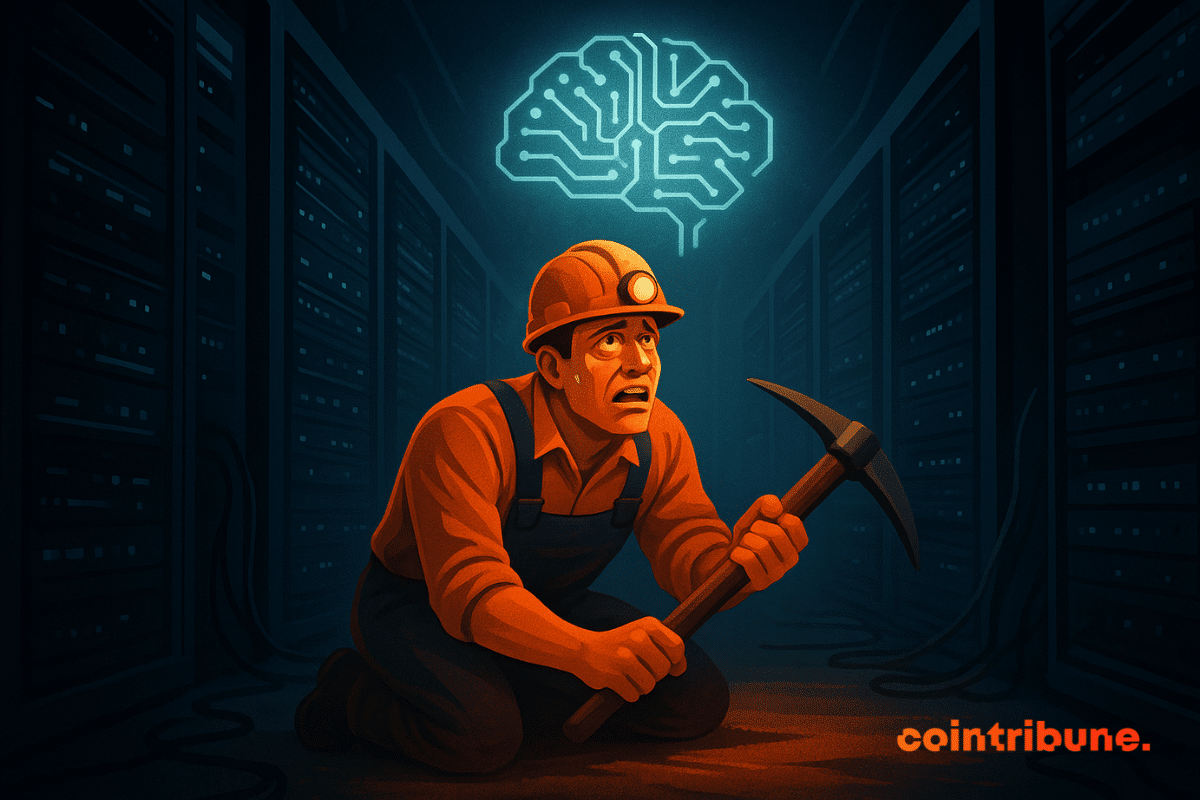
Bitcoin miners are increasingly leveraging substantial debt to finance new equipment and expand their operations into artificial intelligence (AI) and high-performance computing (HPC). This trend is driven by intensifying competition for hashrate and shrinking post-halving profits, compelling miners to seek external financing to maintain their edge in both Bitcoin production and the growing data infrastructure sector.
A recent report from investment firm VanEck indicates a dramatic surge in total debt among Bitcoin miners, escalating from $2.1 billion to $12.7 billion over a 12-month period. This represents a nearly 500% increase, fueled by the necessity for miners to upgrade their hardware and enhance operational efficiency to retain their share of the global hashrate. Analysts Nathan Frankovitz and Matthew Sigel highlighted in VanEck’s October Bitcoin ChainCheck report that failure to adopt newer, more efficient machinery risks a decline in Bitcoin earnings, a phenomenon they term the “melting ice cube problem.”
Historically, mining companies favored equity financing for significant capital expenditures. However, Bitcoin's price volatility has made equity financing increasingly costly. In contrast, debt markets now offer miners greater flexibility as they pursue diversification of their income streams.
Data illustrates a significant increase in debt taken on by mining companies over the past year:
- •The Miner Mag reported that public Bitcoin miners issued a combined $4.6 billion in debt and convertible-note offerings during Q4 2024.
- •At the beginning of 2025, total financing activity experienced a sharp decline to just $200 million, reflecting a market cooldown post-halving.
- •By Q2, borrowing activity rebounded to $1.5 billion as miners accelerated funding for AI and HPC infrastructure growth.
This growing reliance on borrowing underscores miners' strategic adaptation to evolving market conditions.
Miners Diversify into AI and HPC Hosting
Following the April 2024 Bitcoin halving, which reduced block rewards to 3.125 BTC, profitability across the mining sector experienced a significant downturn. In response, many operators have begun repurposing a portion of their energy capacity to offer AI and HPC services. This strategic shift allows them to generate steadier, more predictable cash flows through long-term contracts, thereby reducing their dependence on Bitcoin's volatile price cycles.
Frankovitz and Sigel noted that miners expanding into AI and HPC services are generating more stable cash flows via multi-year contracts. This diversification strategy lessens their reliance on Bitcoin's speculative and cyclical price movements.
The relative predictability of these cash flows has enabled miners to tap into debt markets, diversifying their revenues from Bitcoin’s speculative and cyclical prices and lowering their overall cost of capital.
Frankovitz and Sigel
Several prominent mining firms have initiated substantial financing efforts specifically for AI and HPC infrastructure development. Bitfarms, for instance, closed a $588 million convertible note offering in October to finance new data center projects across North America. Concurrently, TeraWulf announced a $3.2 billion senior secured notes offering to expand its Lake Mariner campus in Barker, New York. IREN also completed a $1 billion convertible notes deal, with a portion of the funds designated for general corporate purposes and working capital.
AI Shift Strengthens Bitcoin’s Energy Ecosystem
While the increasing focus on AI infrastructure might appear to be a departure from traditional Bitcoin mining, VanEck analysts contend that this trend ultimately reinforces the broader ecosystem. Miners are essential for validating Bitcoin transactions, and the continuous rise in hashrates contributes to bolstering network security. They also observe that AI demand fluctuates throughout the day based on user activity, which allows miners to optimize their energy usage by alternating between AI workloads and Bitcoin mining.
The report further revealed that several miners are exploring innovative ways to utilize their power capacity during periods of low AI demand. Some are testing systems designed to repurpose excess energy during off-peak times, potentially reducing or eliminating the need for costly backup power sources like diesel generators.
Although this concept is still in its nascent stages, it could represent a significant advancement in integrating Bitcoin and AI technologies. This development may also enhance how miners manage both their financial and energy resources.
As the hashrate race accelerates and AI adoption expands, miners are entering a new era characterized by high leverage, rapid innovation, and an increasing convergence between digital assets and data infrastructure.