


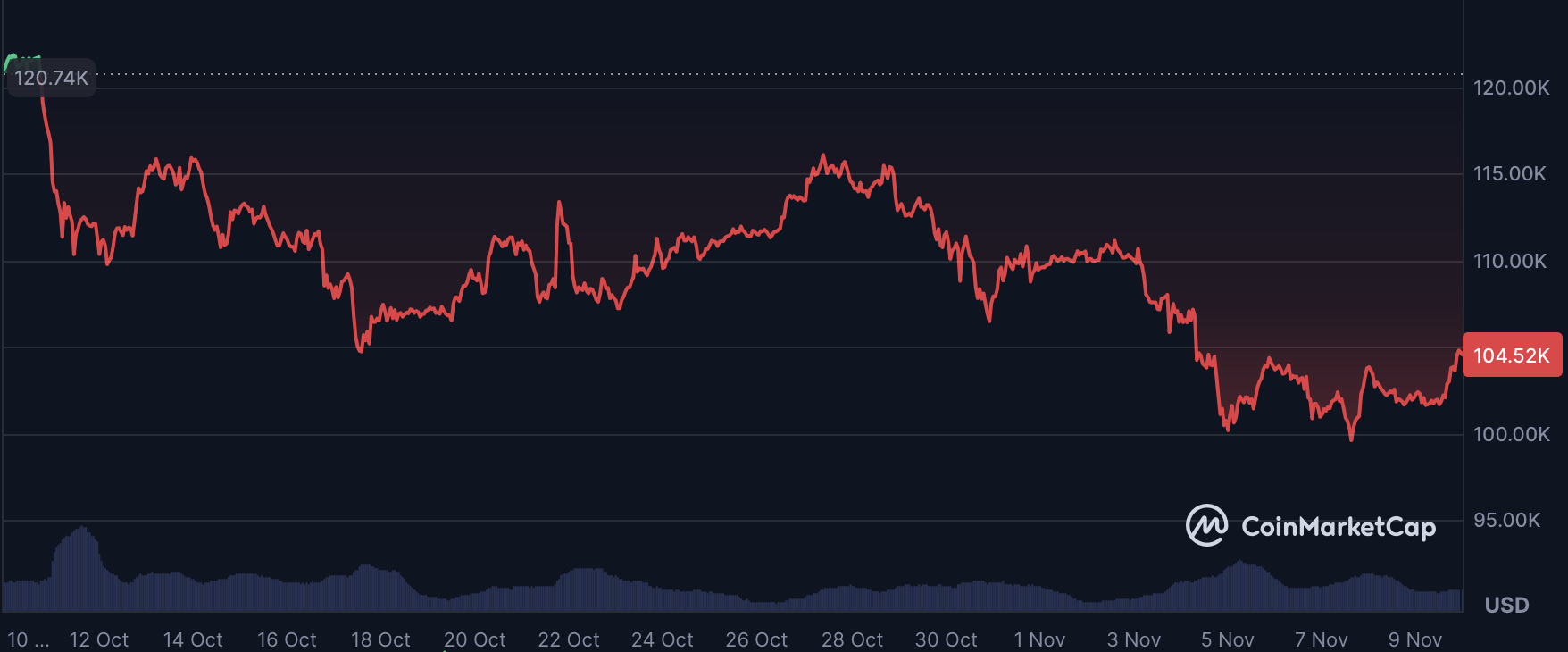
Bitcoin has recovered to $104,500, marking a 2.3% increase in the past 24 hours, driven by renewed buying activity across major exchanges, according to CoinMarketCap data. Despite this rebound, the world's largest cryptocurrency remains down 7.5% over the past month, with a current market capitalization of $2.08 trillion and a 24-hour trading volume of $55.76 billion.
Traders are currently divided on whether this recent upward movement signifies a bottoming phase for Bitcoin or merely a temporary relief rally. Analysts are closely watching a critical technical zone, colloquially referred to as the “Golden Line,” which could be instrumental in determining whether the current bull cycle remains intact or transitions into a more significant correction.
Doctor Profit Highlights the 'Golden Line' as Crucial Support
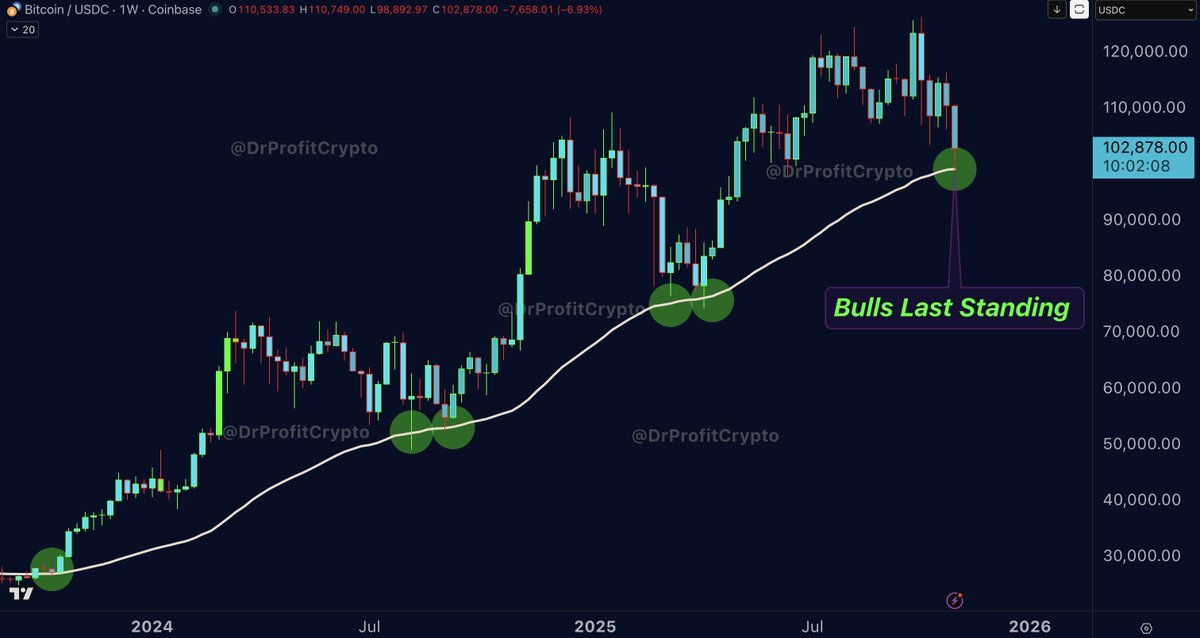
Crypto analyst Doctor Profit has cautioned that Bitcoin's price range between $99,200 and $100,000 represents a historically significant level. This zone has not been breached on a weekly closing basis since the commencement of the 2023 bull run.
"The Golden Line has always held, but if it breaks this time, it could invalidate the bullish structure," Doctor Profit explained, designating this area as the "Bulls' Last Standing." His recent analysis indicates that Bitcoin is currently consolidating above $102,800, having tested this critical threshold multiple times in recent days.
Doctor Profit has indicated that he is not currently buying at the Golden Line, maintaining a fully USDT position. He holds short positions with an average entry around $119,000 and plans to add new entries near $117,000. He anticipates significant volatility later this week as traders position themselves ahead of the Consumer Price Index (CPI) and Producer Price Index (PPI) data releases, which are expected to impact market sentiment and liquidity.
Crypto Rover Observes Continued Accumulation by Large Investors
On-chain data shared by Crypto Rover suggests that large investors are continuing to drive the current market cycle, even as retail participation shows a decline.

Data from CryptoQuant reveals an increase in large-holder accumulation since the recent U.S. elections, occurring concurrently with a reduction in exposure from smaller wallets. Analysts interpret this divergence as a sign of institutional dominance, with large investors quietly absorbing supply from retail exits. This pattern is often considered a precursor to medium-term market recoveries once technical levels stabilize.
DaanCrypto Points to CME Chart for Bullish Zone at $104K
Analyst DaanCrypto has highlighted that Bitcoin's CME Futures chart presents a distinct technical perspective due to the exchange's weekend trading gaps. Consequently, the 200-day Moving Average (MA) and Exponential Moving Average (EMA) are positioned lower than on spot markets, hovering around $104,000, which is the current trading level for Bitcoin.
"These levels have acted as key support zones multiple times this year," Daan wrote. "Maintaining this region could preserve the high-timeframe bullish momentum." He emphasized that institutional traders frequently monitor CME charts for clearer signals, making the $104,000–$110,000 range a critical area to observe in the upcoming days.

Market Outlook: Bulls Defend Support Amidst Institutional Activity
Bitcoin's return above the $104,000 mark provides immediate relief to the market. However, analysts generally agree that the market sentiment remains somewhat fragile. The "Golden Line" support, situated near $100,000, continues to be a cornerstone of bullish sentiment. Simultaneously, sustained institutional accumulation and the confluence of technical indicators on the CME chart suggest underlying structural strength in Bitcoin.
Should Bitcoin manage to maintain weekly closes above $104,000, there is potential for momentum to rebuild as the year concludes. Conversely, a confirmed breach below this level would likely usher in a more substantial correction, potentially targeting $95,000 or lower. Such a move, as warned by many analysts, could significantly alter the trajectory of the 2025 market cycle.