



- •Binance’s new white-label solution lets institutions offer crypto trading using their security and deep liquidity pools for client transactions.
- •This service offers a faster, cost-effective market entry, supporting internalized trading and full control over client liquidity and order flow.
Binance launched a white-label service for financial institutions on Monday. This solution lets banks and brokerages offer cryptocurrency trading to their clients. These companies utilize the exchange’s existing markets and security systems. They do not need to construct their own trading infrastructure.
“Institutions retain full control of the front end — their brand, client relationships, and user experience — while Binance powers the back end: supporting trading, liquidity, custody, compliance, and settlement.”
The service provides access to Binance’s spot and futures trading pairs. It also includes its liquidity pools, asset custody, and compliance technology. Partner firms keep their brand identity and manage all client relationships. Binance operates the backend mechanics for trades and settlements.
Introducing #Binance Crypto-as-a-Service (CaaS)
A white-label solution for corporates and financial institutions to integrate crypto services with full front-end control, powered by Binance’s unmatched infrastructure and liquidity.
Learn more
https://t.co/efBybAglQYpic.twitter.com/Gvsj9iAJCy
— Binance VIP & Institutional (@BinanceVIP) September 29, 2025
Binance reports that institutional demand for digital assets is at a high level. The company believes offering crypto services is now essential for financial firms. This move follows a comparable service from competitor Coinbase, which began in June. A limited group of institutions can access the platform starting Tuesday. A wider launch is planned for the fourth quarter of this year.
“Building the technology, compliance framework, and liquidity pipelines in-house can be expensive, time‑consistent, and potentially high‑risk.”
The Binance package supports internalized trading. Firms can match orders between their own clients internally. They maintain control over their liquidity and order flow. The link to Binance’s deep markets remains as a backup option. A dedicated management dashboard is included. This tool lets institutions watch trading activity, client sign‑ups, and asset movements. It provides a clear window into operational metrics.
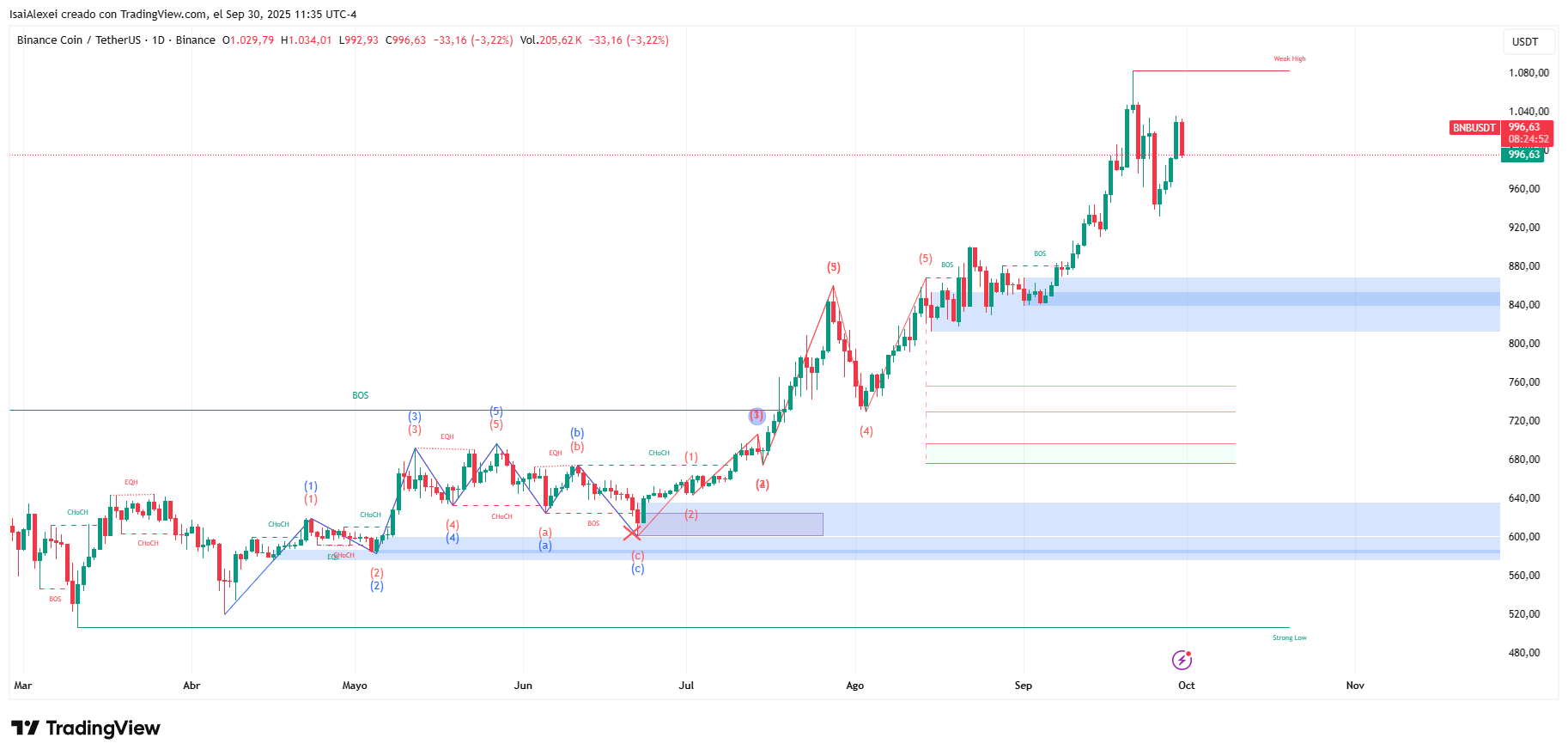
Binance Coin (BNB) is trading at $994.6, down 3.49% in the past 24 hours. On the weekly scale, it is nearly flat with a 0.16% gain, while over the past month it has surged 15.32%. On a longer horizon, BNB is up 68.39% in six months and 66.89% year‑over‑year, with a market capitalization of $138.42 billion and daily trading volume of $3.19 billion.
BNB is currently consolidating around the $934 Fibonacci support level, facing resistance near $1,034 and the all‑time high of $1,083. Analysts warn that a drop below $932 could confirm a local top, while a close above $1,083 may trigger new highs.
Recent developments have fueled market interest. Kazakhstan’s Alem Crypto Fund added BNB to its reserves, recognizing it alongside Bitcoin and Ethereum as a state‑level asset.
Meanwhile, Binance Blockchain Week 2025 in Dubai is drawing institutional attention, connecting BNB with global investors and enterprises. Binance has also expanded its offerings with crypto‑as‑a‑service solutions for traditional institutions, supporting custody, compliance, and trading integration.