


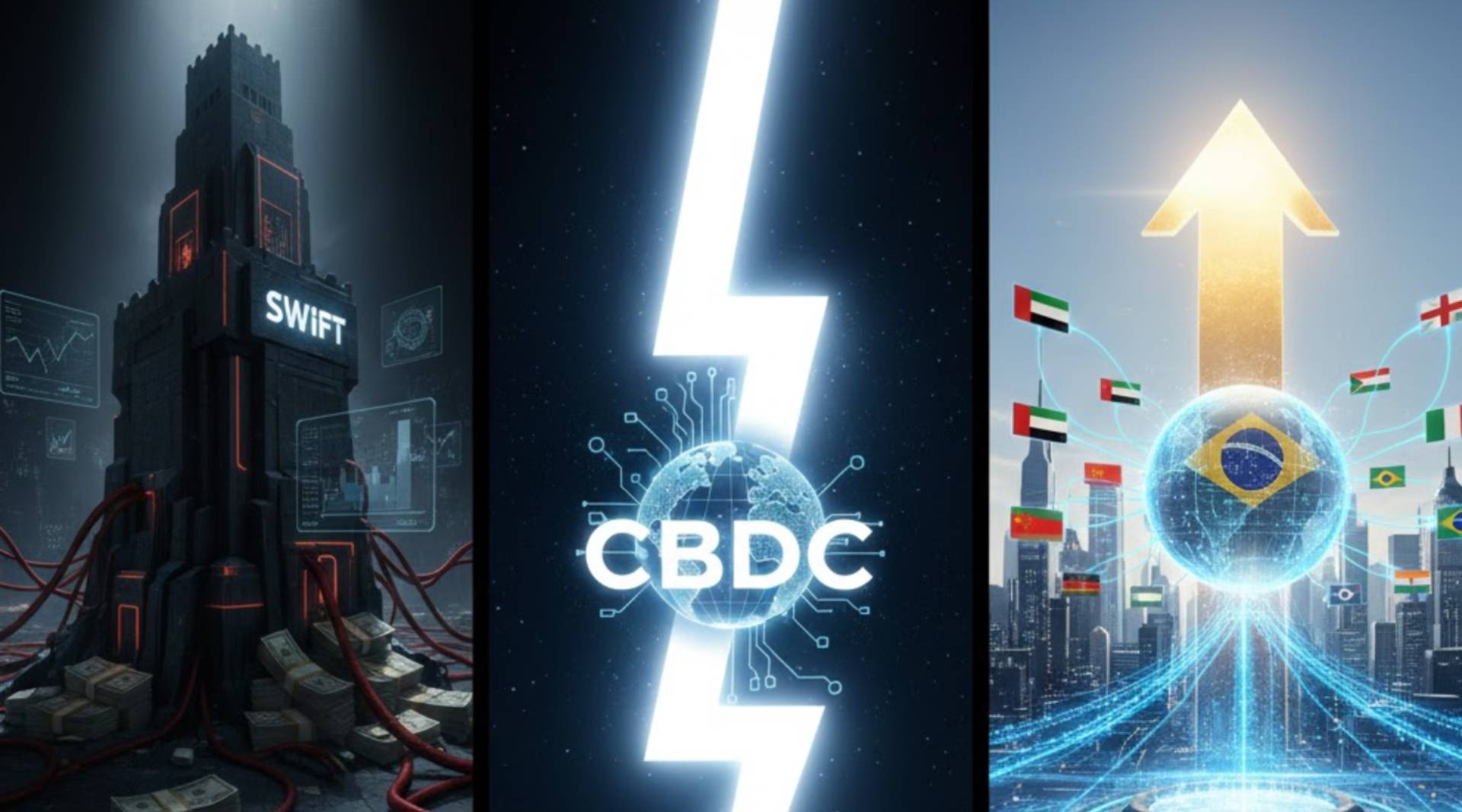
Over four decades of observing monetary systems, from the early days of electronic banking to today's blockchain implementations, I've witnessed how financial infrastructure evolves. This happens not through revolution, but through methodical recalibration. What we're seeing now is precisely that: a new class of digital currencies—on-chain dollars, tokenized fiat, and CBDCs—is beginning to influence global payment flows and reshape the architecture of international settlement.
With initiatives emerging across Asia, the Middle East, and Europe, on-chain national currencies are becoming a compelling alternative to both SWIFT, which processes approximately 45 million messages daily with average settlement times of one to three days, and private stablecoins. The transformation has already begun, and it is accelerating.
The Infrastructure Shift Is Already Underway
Consider what happened in December 2025: the Kyrgyz Republic officially confirmed through an independent Kreston Global audit the precise amount of gold reserves backing USDKG, a state-regulated stablecoin with physical backing of 376 kilograms of gold. This wasn't a theoretical exercise. Auditors physically inspected 30 gold bars, verified serial numbers, examined purity certificates, and confirmed on-chain wallet control. The result: a sovereign-backed digital asset with a level of transparency that most fiat-backed stablecoins have never achieved.
In the Philippines, the National Printing Office has selected Venom blockchain to digitize approximately 10 billion accountable forms, from invoices and receipts to documentary stamps and official documents, in what could become one of the world's largest blockchain use cases for a government. This isn't a theoretical pilot; it's a concrete agreement to transform how a nation of 115 million citizens deals with government documentation.
The European Central Bank completed its two-year preparation phase in October 2025 and has moved to the next stage of the digital euro project. Over 70 market participants, including major European banks, fintechs, and payment service providers, have joined the ECB's innovation platform to test conditional payments and explore use cases. If EU legislators adopt the necessary regulation in 2026, pilot exercises could begin in mid-2027, with potential issuance coming in 2029.
Why Asia and the Middle East Are Leading
The question I'm asked most frequently is why Asian and Middle Eastern governments are leading the way in terms of blockchain adoption. The answer lies at the intersection of three forces: geopolitics, technological sovereignty, and economic efficiency.
First, there's the matter of correspondent banking. The regions where Venom Foundation works most actively—Eastern Africa, Southeast Asia, the Commonwealth of Independent States—are precisely those where correspondent banking has been in retreat. When global banks exit markets, they don't leave behind infrastructure; they leave behind a gap. CBDCs and tokenized fiat offer a way to fill that gap without dependence on institutions whose priorities may not align with local economic development.
Second, consider the demographics. The Philippines alone accounted for 4.75% of global remittance inflows in 2023, with digital transaction volumes across Southeast Asia forecast to reach 765 billion by 2027. These aren't theoretical flows, they're economic lifelines for millions of families. The current infrastructure supporting these flows remains fragmented, expensive, and slow. A three-day settlement window isn't a technical limitation; it's a tax on the working poor.
Third, and perhaps most significant, is the question of monetary sovereignty. Governments in emerging markets are increasingly aware that financial infrastructure is strategic infrastructure. The ability to process transactions through systems you control, using currencies you issue, isn't about isolation, it's about resilience and protection. The recent discussions at the BRICS summit regarding mBridge-based systems underscore this point: nations want options.
The Stablecoin Question
Do CBDCs and tokenized fiat threaten the relevance of private stablecoins? With USDT at approximately $199 billion and USDC at $77 billion in market capitalization, the scale of private stablecoin adoption is undeniable. These instruments have found product-market fit in ways that most CBDCs have not yet achieved.
But I would reframe the question. The issue isn't competition; it's complementarity. Private stablecoins excel at velocity: they're the lubricant of crypto trading and DeFi. CBDCs and sovereign-backed stablecoins offer something different: institutional legitimacy, regulatory clarity, and—critically—the ability to integrate directly with national payment systems and tax frameworks.
What we're likely to see is stratification. Private stablecoins will continue to dominate retail crypto trading. Sovereign-backed instruments will capture the institutional and cross-border settlement markets where compliance matters more than speed. The winner won't be determined by technology alone but by which instruments can satisfy both regulators and end-users simultaneously.
Could On-Chain Currencies Bypass SWIFT This Decade?
This is where I must be careful to distinguish between capability and probability. The technical capacity exists today. Blockchain platforms, including our own at Venom Foundation, can process transactions at speeds and costs that SWIFT cannot match. When we talk about asynchronous processes, pBFT consensus, and dynamic sharding, we're describing infrastructure that can serve hundreds of millions, even billions of people at low cost and high speed.
But financial infrastructure isn't just technology. It's trust, legal frameworks, settlement finality guarantees, and decades of accumulated operational knowledge. SWIFT isn't going to be bypassed by a superior protocol; it will be bypassed when alternative systems offer not just better technology but comparable institutional trust.
Realistically, full bypass is unlikely within this decade for most corridors. What's more plausible is selective adoption: specific bilateral or multilateral corridors where parties have strong incentives to move outside dollar-denominated systems. The UAE-Saudi digital dirham and riyal experiments for oil trade are the template. When the economic incentive is strong enough and the trust relationship already exists, adoption can be rapid.
Which Platforms Will Win?
The blockchain platform question is secondary to the governance question. Governments will choose platforms they can trust, and trust in this context means: regulatory compliance, technical scalability, and the absence of dependence on any single commercial entity or nation-state.
At Venom Foundation, we've been going after governments, commercial banks, and central banks precisely because mass adoption requires institutional-level infrastructure. If it's not compliant and regulated, if it can't scale efficiently and cost-effectively, it's not going to happen. This world we live in is profit-driven – if you're going to cost too much, and if you're too slow, adoption stalls.
The platforms that succeed will be those that can provide sovereign-grade infrastructure while maintaining interoperability with global networks. That's the balance we've been working to achieve: blockchain that governments fully control while keeping it connected to the broader financial ecosystem. This isn't about replacing one form of dependency with another, it's about parlaying the strengths of different options to refine and advance outdated systems.
The Strategic Window
We're at a strategic window where forward-looking governments can build sovereign-grade digital finance infrastructure, designed not just for speed but for transparency, integration, and long-term resilience. The pioneer countries will gain significant competitive advantages: lower costs in international trade, a surge of fintech investment, and the ability to set standards rather than follow them.
Tokenization of money and cross-border settlement isn't a theoretical possibility anymore. It's a concrete choice that monetary authorities are making now. The question isn't whether the architecture of international settlement will change; it's already changing. The question is who will lead that change and who will be forced to adapt to systems designed by others.
For those of us building the infrastructure, this is a rare moment when public interests and technological innovation align. It's a chance to build a transparent, accountable, and efficient financial architecture that serves everyone, from businesses and governments down to the common citizens. The challenge now is to seize it.