



Early access in crypto doesn’t disappear with announcements; it narrows quietly through math. That reality is becoming increasingly visible with Zero Knowledge Proof (ZKP), where 200 million tokens are released every day, prices reset with each cleared auction, and yesterday’s entry conditions never return.
As 2026 unfolds, that fixed rhythm is doing something important: it’s compressing the early phase. Not through hype, but through time. That’s why Zero Knowledge Proof (ZKP) is now being labeled a crypto presale to watch by participants focused on structure rather than noise.
The Daily Release That Changes Everything
Zero-Knowledge Proof’s distribution is deliberately simple. Each day, 200,000,000 Zero Knowledge Proof (ZKP) enter circulation via a public auction. No acceleration. No surprise unlocks. No discretionary changes. Once a day closes, that pricing and allocation are gone permanently.
This matters because most presales stretch early access through phased discounts or private tranches. Zero Knowledge Proof (ZKP) does the opposite. It keeps supply moving at a constant rate, allowing demand to do the pricing work. Over time, that creates a narrowing window where early conditions exist for fewer days, not fewer people.
That mechanism is the first reason analysts consider Zero Knowledge Proof (ZKP) a crypto presale to watch heading into 2026.
Why Zero-Knowledge Proofs’ Entry Window Is Shrinking in Real Time
When 200 million tokens clear daily, two things happen simultaneously. First, total circulating supply increases predictably. Second, the opportunity to buy at earlier price points disappears predictably.
There’s no reset. No reply. No second chance at a prior day’s terms.
Add to that an anti-whale cap of roughly $50,000 per wallet, and the market remains distributed while still advancing. The cap prevents single buyers from absorbing disproportionate supply, but it does not slow the clock. Each day still moves forward, whether participants act or not.
This is the kind of dynamic that turns a presale into a process rather than an event, and why Zero Knowledge Proof (ZKP) keeps surfacing as a crypto presale to watch for observers tracking time-based scarcity.
Built Before Access: The $100M Foundation
Another reason the entry window feels compressed is that Zero Knowledge Proof (ZKP) did not open access while still under construction. The project reports $100 million self-funded to complete its core infrastructure before launching the auction.
That includes its base blockchain, proof systems, compute design, and developer-facing components. In other words, the clock didn’t start ticking while features were promised; it started after they existed.
In a market where many presales ask for patience, this approach shifts the decision-making framework. Participants aren’t waiting for delivery; they’re evaluating timing. That’s a key distinction for anyone assessing a crypto presale to watch rather than a concept to wait on.
Privacy and Verifiable Computation Are Already Live
Technically, Zero Knowledge Proof (ZKP) centers on privacy-preserving computation. It integrates zk-SNARK and zk-STARK proofs, enabling verification without exposing underlying data. This is paired with EVM and WASM compatibility, allowing smart contracts and high-performance compute tasks to operate on the same base layer.
Consensus blends Proof of Intelligence (PoI) with Proof of Space/Storage (PoSp), balancing compute contribution with resource commitment. Importantly, these systems are accessible today via a live testnet in the preview phase, where users can experiment with computation and proof workflows ahead of mainnet.
This readiness reinforces the sense that time, not uncertainty, is the main variable left. It’s another reason Zero Knowledge Proof (ZKP) is frequently cited as a crypto presale to watch rather than a speculative placeholder.
The $5M Incentive Adds Momentum, Not Shortcuts
Zero Knowledge Proof’s $5 million reward allocation, split across ten winners receiving $500,000 each, has drawn attention, but it hasn’t altered the core mechanics. Entry into the reward pool requires holding a Zero Knowledge Proof (ZKP) obtained through the same daily auction as everyone else.
There are no bypasses. No bonus pools. No private access. Referrals (20% to referrer, 10% to referred) increase exposure but do not change supply rules. The incentives sit on top of the system, not around it.
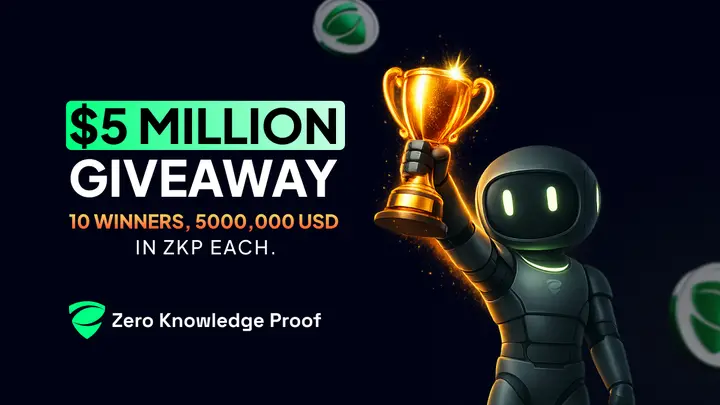
That consistency is crucial. It keeps the focus on timing within the auction rather than chasing promotional advantages, one more reason seasoned observers frame Zero Knowledge Proof (ZKP) as a crypto presale to watch into 2026.
Public Auctions Only, No Quiet Allocations
Perhaps the most defining element of Zero Knowledge Proof’s design is what it excludes. There are no private rounds, no preferred pricing tiers, and no delayed unlocks for insiders. Every token enters circulation through the same public mechanism.
This makes the daily clock especially relevant. When a day closes, everyone moves forward together. There’s no later revelation that someone else entered earlier at better terms.
As a result, the entry window doesn’t slam shut; it tightens steadily. That’s exactly how early access historically disappeared in prior cycles, and why Zero Knowledge Proof’s structure feels familiar to those who’ve studied past patterns.
Final Say
Zero Knowledge Proof (ZKP) doesn’t rely on countdowns or announcements to create urgency. It relies on a fixed daily release, public auctions, and infrastructure that’s already in place. Each day advances the system, whether participants are paying attention or not.
With 200 million tokens moving daily, $100 million built upfront, and no private shortcuts, ZKP’s early entry window is narrowing by design. As history has shown, the quiet phases often matter most, and in 2026, Zero Knowledge Proof (ZKP) is firmly in one of those moments.